
UCP for Hotels: A Hotelier's Guide to Agentic Booking

Most hoteliers reading about Google's Universal Commerce Protocol arrive at a version of the same question early in the conversation: "Is this just another OTA in disguise?"
It's a reasonable instinct. Hoteliers have spent twenty years watching channel after channel emerge with the same pitch — we'll bring you guests — and end up taking 15–25% of every booking they touch, plus the customer email, plus the post-stay relationship, plus the loyalty enrolment moment. The instinct to read every new agentic-commerce protocol through that lens is earned.
But UCP is structurally different from an OTA, and the difference matters for direct-booking strategy in ways that aren't obvious from the announcements. We covered the spec-aligned view of UCP for lodging here. This post is the hotelier-side companion — what UCP for Hotels actually means for revenue management, channel mix, and the direct-versus-OTA question that drives every commercial decision in a property.
The thesis:
UCP is not an OTA. It's a new funnel — Ask → Book — that runs on top of whatever booking infrastructure you already have. Hotels stay as Merchant of Record. The customer data stays with the hotel. The commission economics are not predetermined. But the customer surface — where the booking is made — does change, and that's the part hoteliers should plan around.
This post is the practitioner read.
The hotelier's UCP stack, in one diagram
┌─────────────────────────────────────────────┐
│                                             │
│  AI Agent (Gemini, ChatGPT, Claude, etc.)   │
│                                             │
├─────────────────────────────────────────────┤
│                                             │
│  UCP        ← the agent-facing contract     │
│             (your /.well-known/ucp profile  │
│              and declared capabilities)     │
│                                             │
├─────────────────────────────────────────────┤
│                                             │
│  Booking Engine / Channel Manager           │
│  (SiteMinder, Cloudbeds, Mirai, Cendyn,     │
│   RateGain, Travelclick…)                   │
│                                             │
├─────────────────────────────────────────────┤
│                                             │
│  CRS / PMS                                  │
│  (Opera, Mews, Cloudbeds, Stayntouch,       │
│   Protel, Maestro, Apaleo, RMS…)            │
│                                             │
└─────────────────────────────────────────────┘
Read top-to-bottom: an AI agent reaches your UCP profile to discover what your property can do, transacts via the declared capabilities, and your UCP endpoint serves rooms, rates and availability from your existing booking engine — which in turn is fed by your PMS and rate-management infrastructure.
The crucial implication: nothing underneath UCP needs to change for an agentic booking to work. Your Opera PMS keeps running Opera. Your SiteMinder channel manager keeps running SiteMinder. Your booking engine keeps running. UCP is the new layer on top, not a replacement for the layers underneath.
What actually changes for hoteliers
Five things shift. Naming them clearly because most of the hotelier-facing UCP coverage either over-promises ("the death of OTAs!") or under-explains ("a new protocol for AI agents").
1. The customer surface moves from your website to the agent platform. The single biggest strategic implication of UCP for hotels — covered in its own section below. Today's traveller types your hotel name into Google or Booking.com and books in a browser. The agentic-flow traveller asks Gemini or ChatGPT — "book me three nights at a downtown property in San Francisco from Friday" — and the agent transacts against your UCP endpoint without ever opening your website.
2. The booking funnel compresses, but it doesn't collapse to two steps. Search → click → browse → cart → checkout becomes something closer to ask → clarify → confirm. The clarify step is real — preference negotiation, cancellation-policy questions, ancillary decisions (parking, breakfast, late checkout, room-type swaps), upsell moments — these don't disappear, they migrate from your website's UI into the agent's conversational interface. There's no abandoned cart in the agentic flow because there's no cart to abandon, but the agent and the user can absolutely cycle through "are you sure about this?" multiple times before the booking commits.
3. The merchant-of-record question stays in your favour. Google's published UCP for Lodging explicitly preserves you as Merchant of Record. (The programme is announced with these Merchant-of-Record and data-ownership commitments published; the detailed capability spec is still rolling out, with partner onboarding waitlisted as of mid-2026.) The booking is between the guest and the hotel; the agent platform mediates the conversation but doesn't own the transaction. This is the part that's NOT like an OTA — on the merchant model (Expedia Group, and increasingly Booking.com's "Payments by Booking.com"), the OTA becomes the Merchant of Record itself and displaces the hotel.
4. The commission economics are not yet determined. UCP itself takes no position on what (if anything) hotels pay to be discoverable by agents, or what agent platforms might charge. The candidate models — platform-subsidised (currently Google on Gemini/AI Mode), merchant-paid referral fee, consumer-paid premium agent, hybrid — are all on the table. None of them is settled. The economic shape of the market will emerge from the first 12–24 months of agent-platform adoption. Until it settles, every hotelier should be tracking which agent platforms their inventory is appearing in and what fee structures (if any) are being charged.
5. The direct-booking story changes shape but doesn't disappear. The hotelier ambition of the last decade — get the guest off the OTA and onto direct booking, save the commission, own the relationship — doesn't die in the agentic era. It morphs. The new question is: when the agent transacts directly against your UCP endpoint, is that direct or intermediated? The honest answer: somewhere in between. It's not OTA-intermediated. It's not website-direct either. It's a third channel, and how the economics work will determine whether it lands closer to one or the other.
What stays the same
The list of things that don't change is just as important for revenue managers and direct-booking teams:
- You own the customer data. Email, name, payment, special requests — these come to you, the same as a direct booking does today. UCP's Identity Linking capability lets the user link their hotel loyalty account to the booking flow via OAuth — note that the linkage is user-to-merchant, not agent-to-merchant. The agent passes through the user's authorisation for the loyalty link; the agent's own verifiable identity — how the store trusts the agent itself — is a separate mechanism.
- You own the post-stay relationship. Loyalty enrolment, marketing consent, review requests, re-engagement campaigns — these run from your CRM, not the agent platform's.
- You set the rate. UCP doesn't impose pricing. Whatever your rate management system serves — BAR, AAA, corporate, opaque, member — is what the agent sees and presents.
- Your fulfilment infrastructure is unchanged. Check-in, billing, folios, schedule changes, irregular operations — all of this still flows through your PMS and your existing operational stack. UCP touches only the discover-and-book layer.
- Your reputation channels are unchanged. TripAdvisor reviews, Google reviews, Booking.com reviews — these don't move just because the booking happened agentically.
The customer surface moves — what stops mattering, what newly matters
This is the section to send to the direct-booking marketing team.
Hotels have spent twenty years optimising the direct-booking website: UX above the booking widget, brand storytelling, lifestyle photography, retargeting pixels, abandonment-recovery email sequences, on-site upsell modules, dynamic personalisation by referrer and segment, A/B tests on the CTA copy, cookie-driven member-rate prompting. All of it built around the assumption that the traveller eventually loads a page on hotel.com (or a brand subdomain) and makes a decision in a browser.
The agentic flow doesn't load that page. The booking happens inside Gemini or ChatGPT or Claude, on a surface the hotel doesn't own and can't directly style. The implications, broken down honestly:
What stops mattering (or matters less) in an agent-mediated booking:
- Homepage hero, lifestyle photography above the fold, brand-storytelling content — the agent never visits the homepage, and the structured response your UCP endpoint returns doesn't carry your hero video
- Retargeting pixels (Meta, Google, TikTok) — the agent isn't a browser; nothing fires
- Cart-abandonment email sequences — there's no cart and no email captured pre-booking to send abandonment to
- On-site upsell modules — the modal popup never renders because the modal isn't part of the agent flow
- Dynamic personalisation by site referrer — the agent doesn't carry referrer context the way a browser does
- A/B tests on the booking widget copy, button colour, layout — there's no widget being rendered to test against
- Cookie-driven member-rate prompts ("you're logged in — see your rate!") — addressed below in the rate-parity and loyalty sections; cookies don't work in the agent context
- Site speed below the booking widget — page load on hotel.com is irrelevant if the agent never loads it
- SEO-driven content pages targeting "things to do near {property}" — those still drive content marketing and Google-organic visits, but their role in the booking funnel diminishes when bookings happen elsewhere
What newly matters — and matters more than most hoteliers realise:
- How your property is described to the agent. The agent gets a structured response from your UCP endpoint. The room descriptions, amenity tags, location strings, photo URLs, accessibility info — these are now the only marketing surface the agent sees. Garbage in, garbage out.
- The richness and accuracy of your capability declarations. Every UCP capability you don't declare is a question the agent can't answer about your property. Want the agent to handle "is there a connecting room?" — you need the capability declared.
- The cleanliness of your structured availability response. Latency, stale prices, false-positive availability, error rates — all of these directly affect whether the agent recommends you over the property next door. Agents demote unreliable endpoints.
- Photo quality and aspect ratio for agent UIs. Agent UIs typically render one or two photos prominently — often in different aspect ratios than your hero shots were composed for. The hotelier who supplies square-cropped, well-exposed primary photos wins the visual selection moment.
- Cancellation and policy language clarity. The agent will read your policies and translate them for the user. Clear, machine-parseable policy text becomes part of your conversion funnel.
- Pricing freshness. A stale price returned by the agent is worse than no recommendation — it breaks the user's trust in the agent, which the agent then attributes to the hotel.
- The structured-data feed becomes the new brand-storytelling surface. The room copy, amenity descriptions, location summary, neighbourhood highlights — these now compete for agent ranking attention the way SEO meta descriptions used to.
- Agent-mediated ancillary surfacing. Parking, breakfast, late checkout, room upgrades — these are now bargained for in the agent conversation rather than presented on a modal. If your UCP endpoint doesn't surface them cleanly, they're lost upsell revenue.
The honest summary: most of the direct-booking website's hard work was front-end conversion optimisation that doesn't transfer to the agent surface. The work that does transfer is everything underneath the front end — the data, the structured feed, the booking engine reliability. The direct-booking team needs a new skillset and a new set of metrics.
The rate parity question (now agentic-shaped)
Rate parity is the most-contested commercial question in hotel distribution. The agentic-era version of it is genuinely new and deserves its own section — most hoteliers haven't yet thought through what changes.
Three sub-questions hoteliers are already starting to ask:
1. Can hotels offer agent-direct discounts the way they offer logged-in member rates today? On hotel.com, a logged-in loyalty member sees a member rate that's not visible to anonymous users. In an agent-direct UCP flow, the agent represents the user — so the agent could authenticate as the member via Identity Linking and receive the member rate. The harder question: what stops the OTAs that also consume your UCP endpoint from seeing those same rates and rewriting them onto their own surfaces? The answer is partly contractual (your rate-shopping disclosure terms) and partly technical (segmenting which capabilities and which rates are visible to which agent identity). UCP doesn't yet have a standardised way to handle this; the workarounds will be vendor-specific in 2026 and 2027.
2. Does "agent-direct" count as direct under your OTA contract's parity clauses? Almost no OTA contract written before 2026 explicitly addresses agent-mediated direct booking. The lawyers will eventually catch up; in the meantime, hotels with strict parity clauses (Booking.com Genius, Expedia Group's parity terms) will face the question of whether offering an agent-direct member rate is technically a parity breach. The answer is unsettled. Most hotel-distribution counsels are interpreting it conservatively, which slows agent-direct adoption.
3. Will hotels need different rates for different agent platforms? The metasearch precedent says yes. Hotels routinely set different bids and prices for Google Hotels vs Trivago vs TripAdvisor metasearch placements. The agentic equivalent — different rates surfaced to Gemini vs ChatGPT vs Claude — is the same shape: each platform has different conversion characteristics, audience composition, and commercial relationship. Expect the largest chains to develop platform-specific rate strategies once enough agent platforms reach commercial scale; expect independents to lag because the operational complexity is real.
For revenue managers reading this: the practical near-term answer is don't change parity strategy unilaterally yet, but track every agent-platform appearance and rate displayed so you have data when the contracts get renegotiated. The contracts will get renegotiated.
Loyalty: the operational complexity nobody's solved yet
For Marriott Bonvoy, Hilton Honors, IHG One Rewards, World of Hyatt, ALL — Accor Live Limitless, and every other large hotel loyalty programme, the loyalty membership is more valuable to the chain than any single booking. Loyalty drives direct repeat business, supports premium-room margin, locks in lifetime value, and is the single most-defended asset in any hotel-distribution conversation.
The agentic flow re-opens four loyalty questions that the direct-booking website had already mostly solved. None of them are settled yet.
1. How do points get earned through an agent booking? The booking confirmation needs to carry the member number so the property credits points to the right account. UCP's order metadata can carry it — but only if the user has linked their loyalty programme into the booking flow (via Identity Linking) so the agent can pass the linked credential through to the hotel. Today, that user-side linkage is essentially zero. The first hotel groups to ship clean Identity Linking flows will collect the bookings cleanly; the rest will see points-uncredited bookings and the customer-service complaints that follow.
2. How does status get recognised at booking time? A Bonvoy Titanium member sees different rates and amenities than an anonymous user. For the agent to apply the right rate, the agent has to know the user's status — which again requires Identity Linking AND the property's UCP endpoint to surface status-tier-aware availability. Today, most hotel booking engines don't expose status-tier rates over a structured API at all.
3. How do member rates apply? Related but distinct from status recognition: even non-status loyalty members often get a member-only rate (a 5–15% discount in exchange for membership). For UCP-mediated bookings, the agent needs to know the user is a member AND the endpoint needs to expose member-rate availability. Both require infrastructure most hotels haven't built yet.
4. Where does the enrolment moment happen? Today, hotel websites have prominent "join + book" flows — a high-converting moment where a first-time guest enrolls in the loyalty programme during the booking. The agent flow has no website to host that flow. Where does enrolment happen? The candidate answers: (a) the agent itself prompts ("you'd save 8% on this booking by joining Marriott Bonvoy — want me to enroll you?"), (b) the property prompts post-booking via email, (c) the property prompts at check-in. Each shifts the enrolment moment to a different point in the customer journey and changes the conversion economics. The hotel chains that figure out option (a) first — and convince the agent platforms to surface their enrolment offer — gain the structural advantage.
For branded hotels, these four questions are arguably more important than the OTA disintermediation question. The OTA share shift will play out over years; the loyalty enrolment moment is being lost or won with every agent-mediated booking happening today.
The four vendor categories hoteliers need to know about
UCP readiness for any individual property depends on what your current technology stack does, not just on what your brand decides centrally. Four vendor categories matter, in order of how directly they touch UCP-readiness:
Channel managers
Companies like SiteMinder, Cloudbeds, RateGain, Cendyn, Travelclick, D-Edge, Profitroom sit between your inventory and the world. The agentic future doesn't kill channel managers — it makes them one of the most likely homes for UCP endpoint operation at the property level. Single-property hoteliers will lean on their channel manager to expose UCP on their behalf. Group-level hoteliers may build UCP endpoints centrally and have the channel manager continue to serve OTA channels in parallel.
PMS vendors
Opera (Oracle), Mews, Cloudbeds, Stayntouch, Protel, Maestro, Apaleo, RMS Cloud. The PMS doesn't typically expose UCP directly — that's the booking-engine or channel-manager job — but the PMS is the system of record for the data UCP needs (availability, room types, rates, restrictions). Modern API-first PMS vendors (Mews, Cloudbeds, Apaleo, Stayntouch) have a structural head start on UCP-readiness over the older closed-architecture systems.
Booking engines
SiteMinder Booking Engine, Cloudbeds, Mirai, Cendyn (Pegasus), Travelclick (now part of Amadeus), D-Edge, Profitroom, Bookassist. The booking engine is the most direct path to UCP exposure for many properties — your existing direct-booking funnel becomes the foundation that the UCP endpoint serves from. If your booking engine vendor adds UCP support, your property becomes UCP-discoverable with little or no engineering work on your side.
Metasearch and OTAs
Booking.com, Expedia Group, Trip.com Group, Hopper, Kayak, Trivago, Google Hotels. These are the layer above the channel manager today; in the agentic era, they have to decide whether to compete with agent platforms (by exposing their own aggregated UCP endpoints) or be intermediated by them. The Google Hotels question is particularly interesting because Google is simultaneously the platform building UCP and a metasearch player whose business model UCP partially disrupts.
The OTA question (the one everyone asks)
Are OTAs going to lose share?
Honest answer: yes and no, in ways that depend on the OTA.
OTAs as discovery surfaces lose share to agent platforms. A traveller asking Gemini "find me a hotel in Lisbon" does not visit Booking.com first. The discovery moment moves into the agent. Booking.com, Expedia, Trip.com — all the OTAs whose primary value-add is helping travellers find a hotel — face structural pressure as that surface moves.
OTAs as inventory aggregation surfaces likely don't. The reason agents will end up consuming OTA inventory rather than going hotel-direct in many cases is the same reason metasearch has always existed: aggregated multi-property comparison is genuinely useful. An agent platform looking to compare ten hotels for one stay is probably going to consume an aggregated UCP endpoint from a major OTA rather than fan out to ten individual hotel UCP endpoints — at least until hotel UCP coverage is dense enough that direct fan-out becomes faster.
The middle layer is where the real disruption lands. Trivago, Kayak, Skyscanner, TripAdvisor's metasearch product — the dedicated comparison layer between OTAs and consumers — is the layer that gets compressed hardest. Agents do comparison natively. There's no separate "compare" step in the agentic flow.
The takeaway for hoteliers: the OTA question isn't binary. Booking.com isn't dying tomorrow. But the share of bookings that flow through a traveller-visits-Booking.com browser session will decline, and the share that flow through agent-platform-transacts-against-an-aggregated-UCP-endpoint-that-Booking.com-publishes will rise. The economics of that shift are not yet visible.
Common questions hoteliers ask
These are the exact questions hoteliers send each other when they first encounter UCP. Direct answers, anchored in the published spec and the hotelier-side practical reality.
What is UCP for Hotels?
UCP for Hotels is the agent-facing contract that lets AI shopping agents discover, query, and book your rooms directly — without sending the traveller to your website first. It's an open standard from Google, published as part of the broader Universal Commerce Protocol, designed so that any AI agent (Gemini, ChatGPT, Claude, and others) can transact against any hotel's UCP endpoint using a common vocabulary. The hotel stays as Merchant of Record, the customer data flows back to the hotel, the booking infrastructure underneath (your PMS, your channel manager, your booking engine) is unchanged. UCP is the layer on top, not a replacement for what you already run.
Is UCP going to replace OTAs?
No, but it does compress the OTA's role. OTAs as discovery surfaces (where travellers find hotels) face structural pressure as that moment moves into AI agents. OTAs as aggregation surfaces (where agents shop multi-property comparisons) likely persist for the same reason metasearch always has — aggregated comparison is genuinely useful. The metasearch middle layer (Trivago, Kayak, Skyscanner) is the layer most directly displaced because agents do comparison natively.
Do hotels pay commission on UCP bookings?
Not to UCP itself — UCP is a protocol, not a commercial entity. The agent-platform economics are not yet determined. The candidate models for who pays whom in agentic hotel booking include Google subsidising the funnel (current default in early Gemini/AI-Mode flows), merchant-paid referral fees (the metasearch model applied to agents), consumer-paid premium agent tiers (the user pays for agent capability), or hybrids of these. The economic shape of the market will emerge over the next 12–24 months as agent platforms scale.
Does UCP affect rate parity?
Not automatically, but it raises three new sub-questions covered in the rate-parity section above: (1) can hotels offer agent-direct member rates without OTAs consuming the same UCP endpoint also seeing them, (2) does "agent-direct" count as direct under existing OTA parity contracts written before 2026, and (3) will hotels need to set platform-specific rates per agent (Gemini vs ChatGPT vs Claude) the way they already do for metasearch placements. None of these are settled in 2026; the practical revenue-manager advice is to track agent-platform appearance and displayed rates carefully, but not change parity strategy unilaterally yet.
What should hoteliers do this quarter to prepare?
Three things, in order: (1) Ask your booking engine and channel manager vendor whether UCP support is on their 2026 roadmap. (2) Make sure your direct-booking funnel is technically clean — UCP serves from your booking engine, and a flaky booking engine becomes a flaky UCP endpoint. (3) Track which agent platforms your property appears in starting now — search "book hotel at [your property name]" in Gemini, ChatGPT, and Claude, and log what you see. That last one costs nothing and tells you, before any spec or commercial decision lands, whether you're already being discovered by agents. The early signal is more valuable than waiting for clean reporting.
What hoteliers should do now — a ten-item practical checklist
In rough priority order:
- Read the official UCP for Lodging page on Google for Developers. This is the canonical source. Forty minutes of reading, and you'll know more than 90% of hoteliers having the agentic-commerce conversation.
- Map your stack — your PMS, your CRS, your booking engine, your channel manager, your loyalty platform. Know which one will likely host your UCP endpoint when the time comes (usually the booking engine or the channel manager).
- Ask your booking engine vendor whether UCP is on their 2026 roadmap. If they don't have an answer, that's an answer. Make a note for your next vendor review.
- Ask your channel manager the same question. Many properties will end up with their channel manager exposing UCP on their behalf — get ahead of that conversation.
- Track agent-platform appearance now. Try booking your hotel via Gemini, ChatGPT, Claude. Log what happens. Repeat monthly. This costs nothing and gives you signal before any commercial framework is in place.
- Audit your direct-booking funnel for technical hygiene. UCP serves from your booking engine — a slow or buggy booking engine becomes a slow or buggy UCP endpoint. Now is the time to fix latency, broken availability, and stale rate caching.
- Make sure your
/.well-known/ucpwill be valid when it exists. Run a check against your domain today to see what (if anything) is currently published. - Review your loyalty enrolment flow. Agentic bookings can transfer the customer to your loyalty programme via UCP's Identity Linking capability — but only if your enrolment flow is structured to receive that signal. Most aren't yet.
- Get your rate management strategy ready for a new pricing surface. Agent platforms will surface prices in a new way; rate parity, channel-specific pricing, and member-rate strategies will need to think about this surface explicitly.
- Talk to your loyalty/CRM vendor about agent-mediated post-stay communications. When a guest books via an agent, the post-stay sequence still flows from your systems — but only if the booking record carries the right channel attribution. Make sure it will.
The one-line summary
UCP is not an OTA. It's a new agent-facing booking funnel that runs on top of your existing booking infrastructure, preserves you as Merchant of Record, and changes the customer surface without changing who owns the customer data. The commercial model is unsettled; the technical readiness work is mostly the same direct-booking hygiene you should already be doing.
If you want to see what UCP looks like in practice across thousands of verified merchants — the same architectural pattern hotel booking engines will end up implementing — browse the directory or run a free check on your own property to see what (if anything) is currently published at your /.well-known/ucp.
- Check your hotel's UCP profile: ucpchecker.com/check
- Browse the directory: ucpchecker.com/directory
- Developer guide to /.well-known/ucp: ucpchecker.com/well-known-ucp
- Spec-aligned view: Google Opened UCP for Lodging. We Already Tested What It Needs to Handle.
- Travel ecosystem view: Agentic AI in Travel: Why UCP Isn't Travel-Ready Yet — and What We Measured
- For airline distribution teams: UCP vs NDC: What Airlines Actually Need to Know
- Background reading: We Tested 5 AI Models on Expiring Travel Inventory — Here's How They Failed
Check your domain's UCP status
See if your storefront is ready for agentic commerce in seconds.
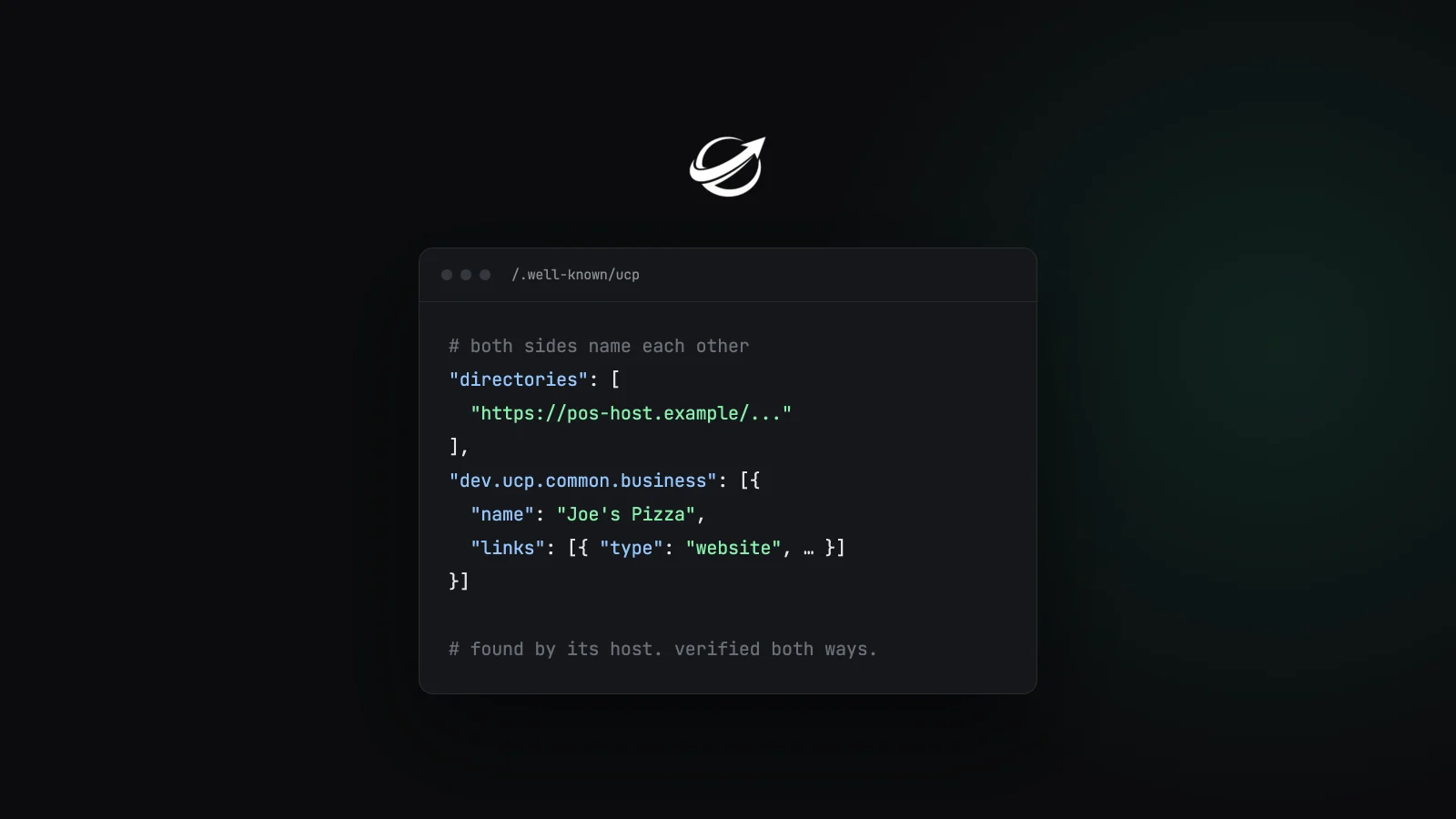
UCP Business Directory and Business Identity: Amazon's Three RFCs Explained
Amazon's UCP Tech Council member has proposed a hosted business directory, a business identity capability and event webh...
UCP Local Services: What the Charter for a Booking Council Proposes
Stripe has filed a charter for a UCP Local Services council, backed by Meta, Wix, Squarespace, Housecall Pro, Jobber and...
Personal Agent Protocol (Poppy) v0.1: What the Spec Says and How It Fits With UCP
Meta and Sierra's Personal Agent Protocol now has a spec. Draft 0.1 defines poppy.json discovery, OAuth sign-in with rea...
Get the agentic commerce digest every Monday
Real adoption data, ecosystem trends, new spec versions, and the stores that broke or recovered this week. Read by founders and engineers building the next generation of commerce.