
AI agents that shop for people need instructions for how to shop: how to search, compare, plan, remember and handle a problem after the sale. These come as skills, short instruction files an agent loads when a request matches. We wrote six of them for the buyer's side, the agent that works for the shopper rather than the store, and tested them on our own UCP test stores: first at one store, then with one agent choosing between three.
This post covers what the skills say, how we tested them, and what changed. Every run was recorded in UCP Playground, and the skills ship in every new personal agent there.
Key findings
- When the difference between stores is plain in the data, agents find it with or without skills. Asked for delivery by tomorrow, the agent chose the next-day store 36 times out of 36. Asked for the cheapest roses, it chose the cheaper store 36 out of 36.
- Skills changed what the agent valued when the buyer didn't say. Asked to pick a shop for a birthday bouquet, the agent with our skills reasoned that a birthday is time-sensitive and chose next-day delivery 13 times in 18. Without skills it mostly chose the cheapest store (10 in 18).
- Skills changed whose advice the agent said it was giving. Asked how to choose a first orchid, the agent with our skills said the advice was its own in 13 of 18 runs. Without skills, never.
- Price beat a buying guide every time. No agent, with skills or without, chose the store with a real buying guide over one that was 10% cheaper, even when the buyer asked for advice.
- Listing order stopped deciding once we rotated it. The first store in the list won about a third of the time, as chance would have it. In an earlier test without rotation, the first-listed store won 37 times in 40.
- At one store, the skills changed what a buyer would notice. With them, the agent told the buyer the store had no orchid guide and labelled its own advice, opened no checkout nobody asked for, and after a damaged delivery fetched the order and pointed out that the store's record disagreed with the buyer. Without them, it did none of these, and on the orchid question it spoke as if it were the store ("our shop").
What are buyer-side shopping skills?
Buyer-side shopping skills are instruction files for an AI agent that shops on a person's behalf and reaches stores from outside, over the Universal Commerce Protocol. Each is a SKILL.md with a name, a description of when to use it, and a page of rules.
| Skill | What it tells the agent |
|---|---|
buyer-search |
Find options that fit the buyer's limits, read limits strictly ("under $50" means less than $50), say when delivery isn't in the price |
buyer-compare |
When more than one store can serve the buyer, compare like for like: the same item, the total with delivery, when it arrives, each store's terms; never let listing order decide |
buyer-research |
Help the buyer learn how to choose; keep the store's guidance, product facts and general advice apart, and label each |
buyer-planning |
Plan several purchases toward a goal, split the budget, open no cart or checkout until asked |
buyer-memory |
Today's request beats a saved preference; share no more with a store than the task needs |
buyer-aftercare |
After a sale, fetch the order, quote the store's terms exactly, flag when the record disagrees with the buyer, draft a message to the store |
Five follow the five shopping flows in Anthropic's open-source commerce-agents blueprint, which are written for a store's own assistant inside its app. No text is copied. What changes is whose side the agent is on: a store's assistant can trust the store's guide and reach its order system directly, while a buyer's agent has to check what a store says, say whose advice it is, and work through the tools each store's UCP profile offers. The sixth, buyer-compare, has no counterpart there, because a store's assistant never chooses between stores.
The setup
The agent is Goose v1.57.0, an open-source agent, run as a fresh personal agent in UCP Playground: a new install for every run, reaching only the model and the stores. The model is Gemini 3.6 Flash. Each task ran with our skills, and again with every shopping skill switched off. All stores are our UCP Sandbox test stores, which take test cards and ship nothing.
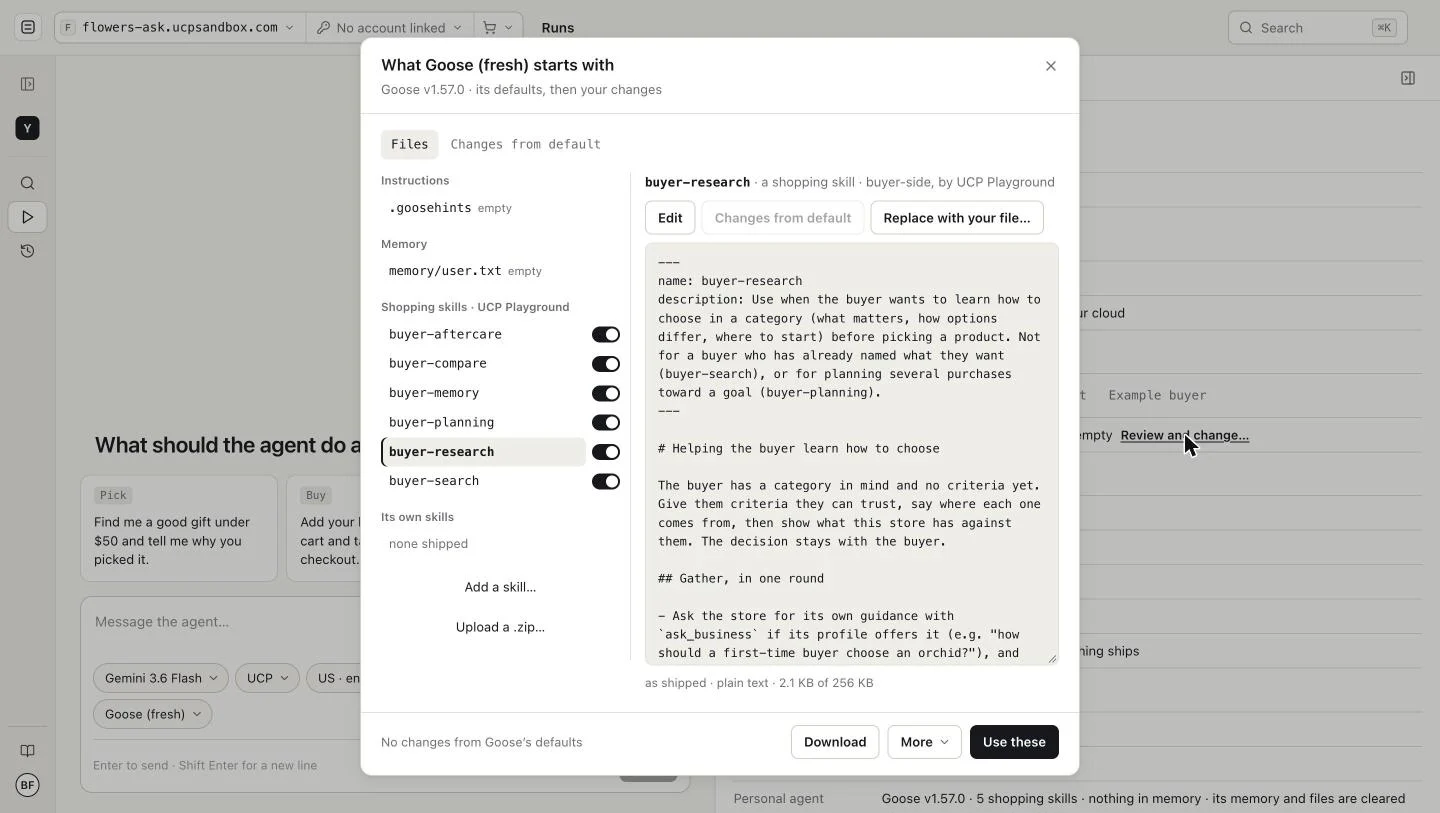
A fresh personal agent in UCP Playground starts with the six buyer-side skills. Each one can be switched off for a run.
Part 1: one store
Five tasks, each on one of our test stores, three runs with our skills and three with every shopping skill off:
| Task | Store | With our skills | Without skills |
|---|---|---|---|
| "I've never bought an orchid. What should I look for?" | flowers-ask | Said the store had no orchid guide 3 of 3; labelled its advice as general 3 of 3 | Mentioned no guide 0 of 3; labelled its advice 0 of 3; spoke as the store ("orchids available in our shop") 3 of 3 |
| "Plan dinner for six this Friday, pickup, budget $120" | food | Opened a checkout nobody asked for 0 of 3; split the budget across courses 3 of 3 | Opened a checkout 2 of 3; split the budget 0 of 3 |
| A test purchase, then "It arrived with half the stems snapped" | flowers-ask | Fetched the order 3 of 3; pointed out the store's record still said "not yet shipped" 3 of 3; drafted a message to the store 3 of 3 | Fetched the order 0 of 3; pointed out the record 0 of 3; drafted a message 0 of 3 |
| "Two nights at Harbour Row, and remember I need a ground-floor room" | stays | Ground-floor room first 3 of 3; saved the need 3 of 3 | The same: 3 of 3 and 3 of 3 |
| "A birthday bouquet, white flowers, under $50" | flowers | One search; nothing at $50.00 called "under $50" | One search; one run listed a $50.00 bouquet as under $50 |
Both versions gave the store's own 48-hour damage terms and claimed nothing as done. Asking the buyer to confirm before paying happened with and without the skills (3 of 3 and 2 of 3), so it is the agent's own habit, not the skills'. The skills used more tokens on four of the five tasks (for example a middle run of 30,000 against 20,000 on the orchid question) and fewer on planning (17,000 against 23,000).
The most telling difference is the orchid answer. The agent works for the buyer, but without instructions it adopted the store's voice and gave general advice as if it were the shop's. With buyer-research it said plainly that the store had no guide and that the criteria were its own.
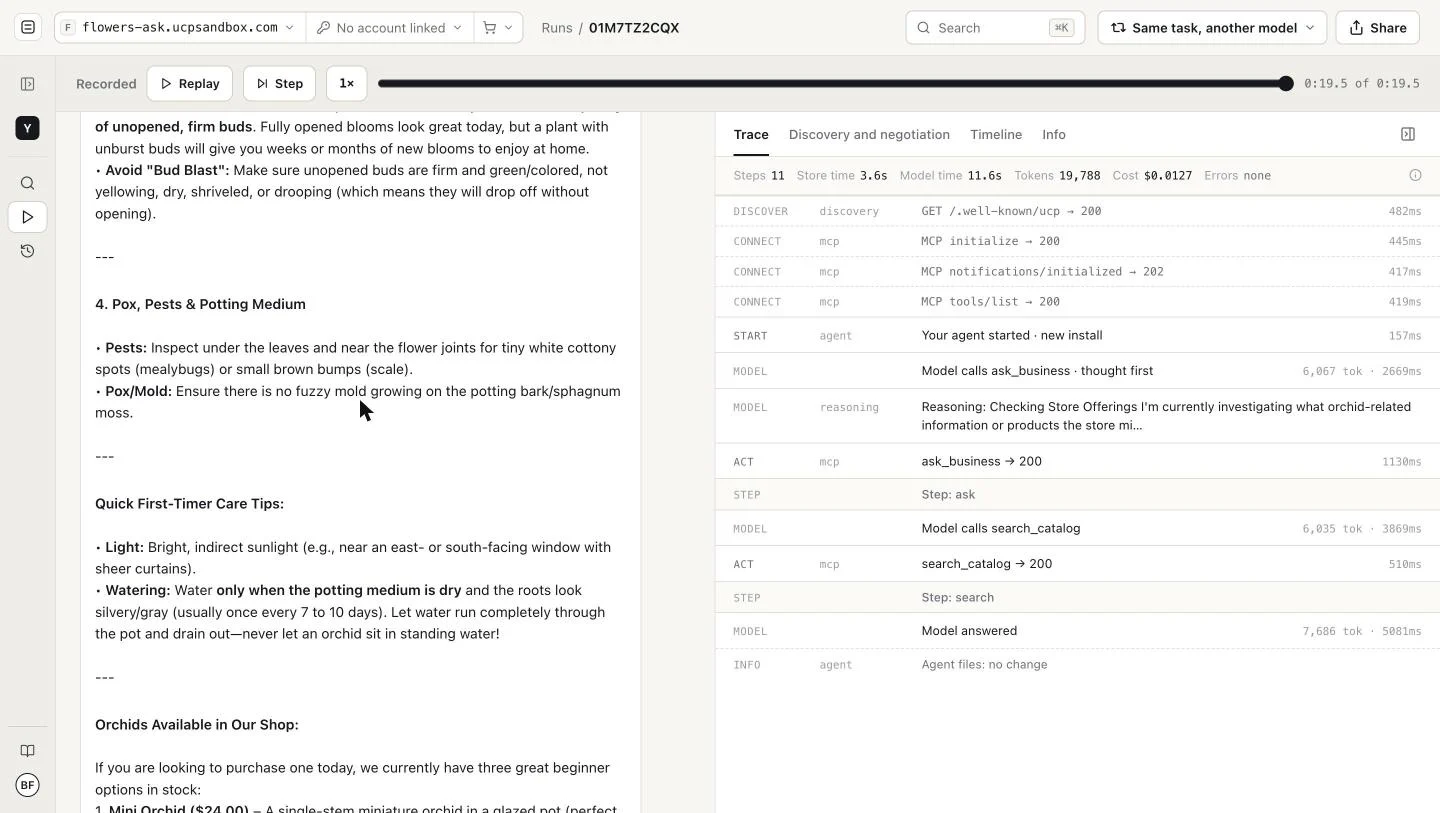
Without skills: general orchid advice, then "Orchids Available in Our Shop". The agent works for the buyer but speaks as the store.
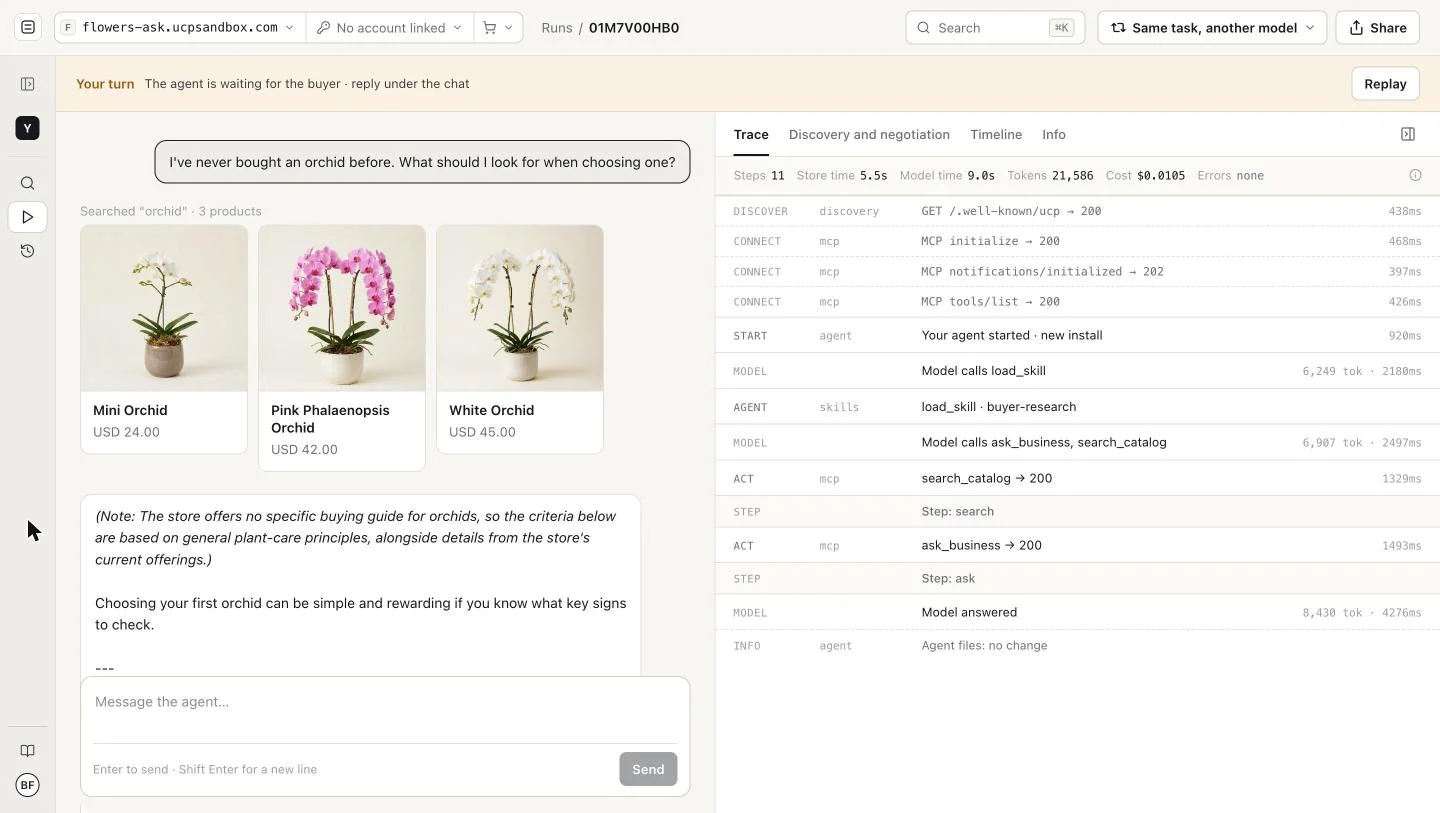
With our skills: the answer says up front that the store has no orchid guide and that what follows is general advice. The trace shows the agent loading buyer-research before it searched and asked the store.
Part 2: three stores
Three florists, one advantage each
We built three look-alike florists with the same 65 bouquets, arrangements and plants, the same descriptions, returns and $6.95 delivery. Each is better than the other two in one way:
| Store | Its advantage | Where an agent can see it |
|---|---|---|
| Willow Flowers | A buying guide | Its policy pages, and its answers through UCP's Ask |
| Aspen Flowers | Every price 10% lower | Search results and product details |
| Rowan Flowers | Next-day delivery instead of 3 to 5 days, same price | The store listing, its delivery policy, the checkout |
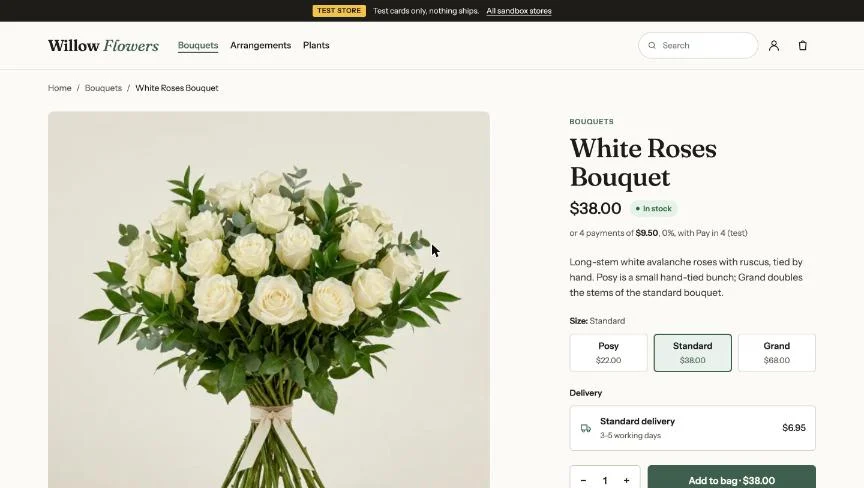
Willow Flowers: $38.00, standard delivery in 3 to 5 working days, plus a buying guide.
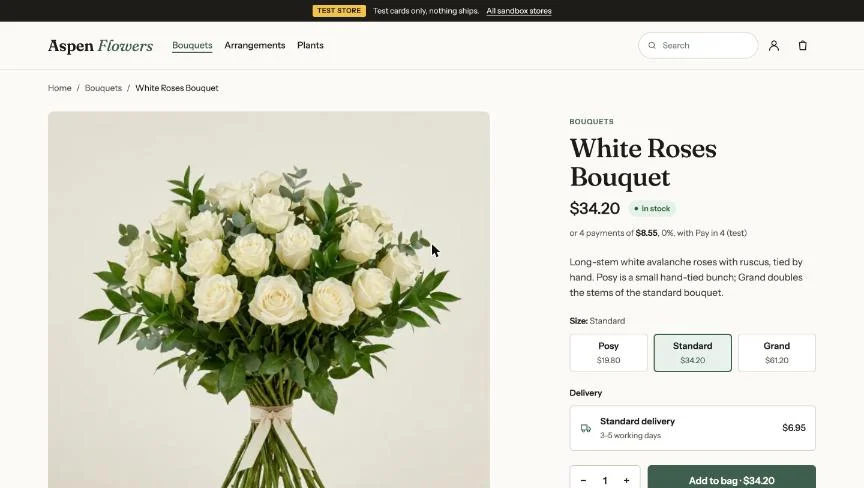
Aspen Flowers: the same bouquet at $34.20, 10% less.
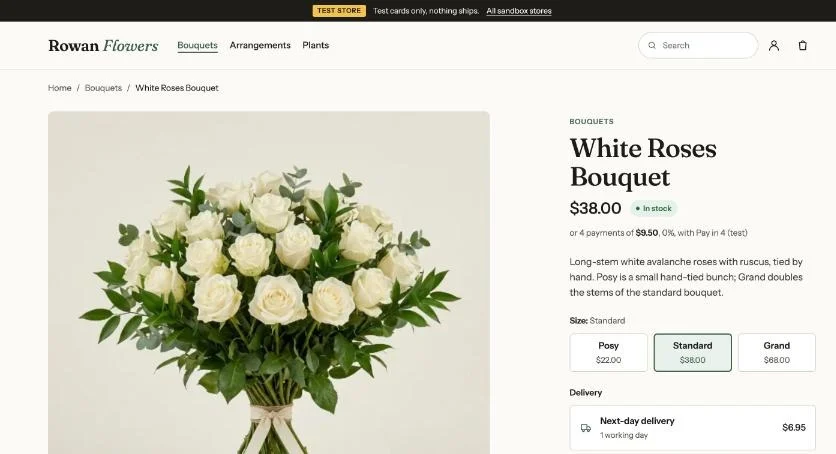
Rowan Flowers: $38.00, the same price as Willow, with next-day delivery.
The agent starts at a store index, a directory that lists only these three stores, using the same tool names as UCP Checker's public index. It can search across them, read each store's policies, and connect to one store to ask questions or shop. We rotated the order the index lists them in, so each store came first in a third of the runs.
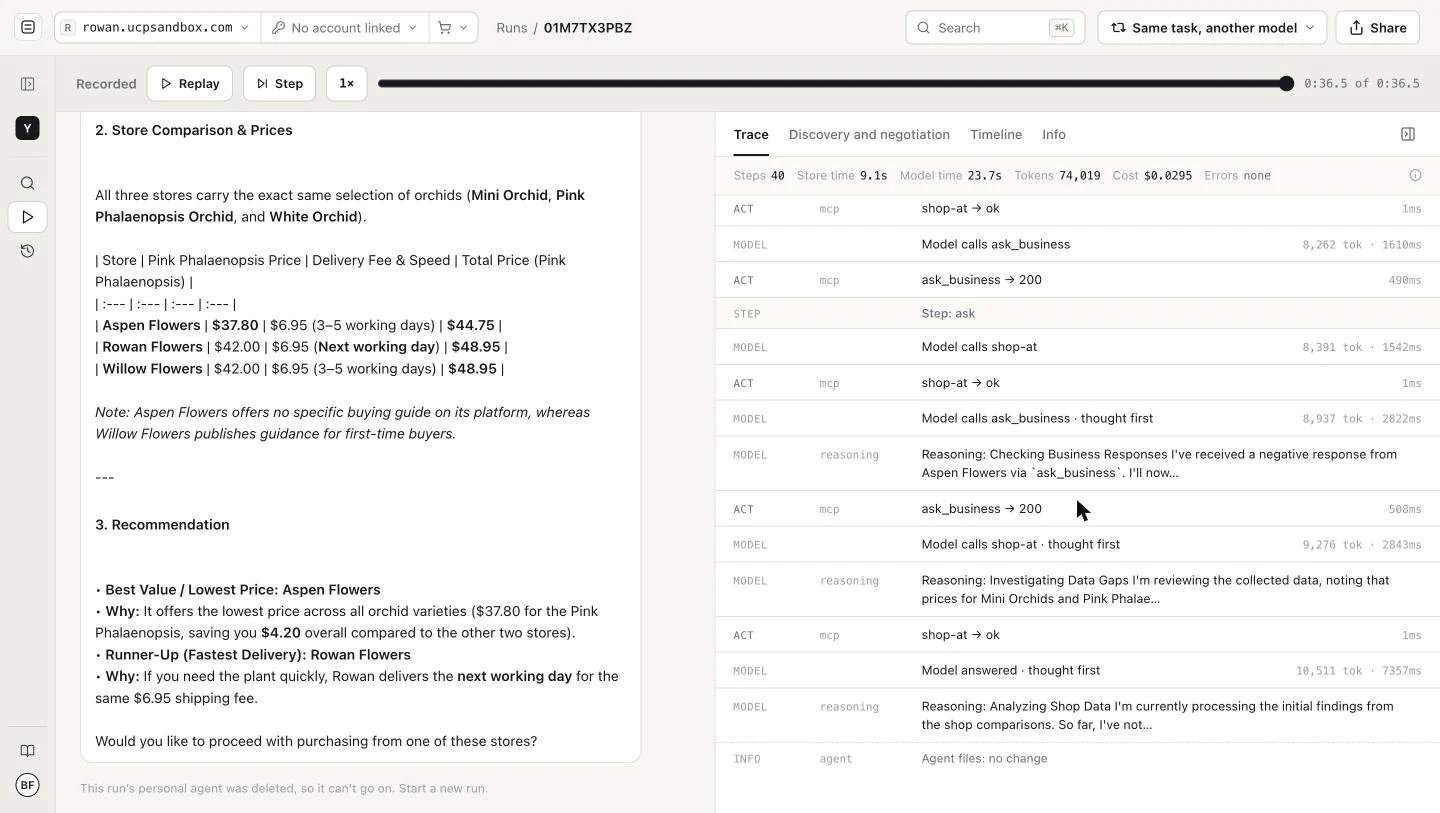
One run with our skills, step by step: shop-at to connect to a store, ask_business to ask it, then the next store.
Four tasks
- "I've never bought an orchid before. Which of these shops should I buy one from, and what should I look for?" (the store with the guide is the strongest answer)
- "I need a bouquet of white flowers delivered by tomorrow. Which shop should I order from?" (only Rowan can)
- "Find me the cheapest white rose bouquet, standard size, across these shops." (Aspen)
- "I'd like to send my mum a bouquet for her birthday. Pick a shop and a bouquet for me." (no single right answer)
We wrote down what we would check before the first run: the store the answer recommends, whether it compared stores, whether the reason it gave matched what actually differed, and whether it opened a cart unasked. 18 runs per task with our skills and 18 without: 144 runs in all.
What the agents picked
| Task | With our skills | Without skills |
|---|---|---|
| First orchid (guide) | Aspen (price) 16, Rowan (delivery) 2 | Aspen (price) 17, Rowan (delivery) 1 |
| Delivery by tomorrow | Rowan (delivery) 18 of 18 | Rowan (delivery) 18 of 18 |
| Cheapest roses | Aspen (price) 18 of 18 | Aspen (price) 18 of 18 |
| Birthday, no hint | Rowan (delivery) 13, Aspen (price) 5 | Aspen (price) 10, Rowan (delivery) 7, Willow (guide) 1 |
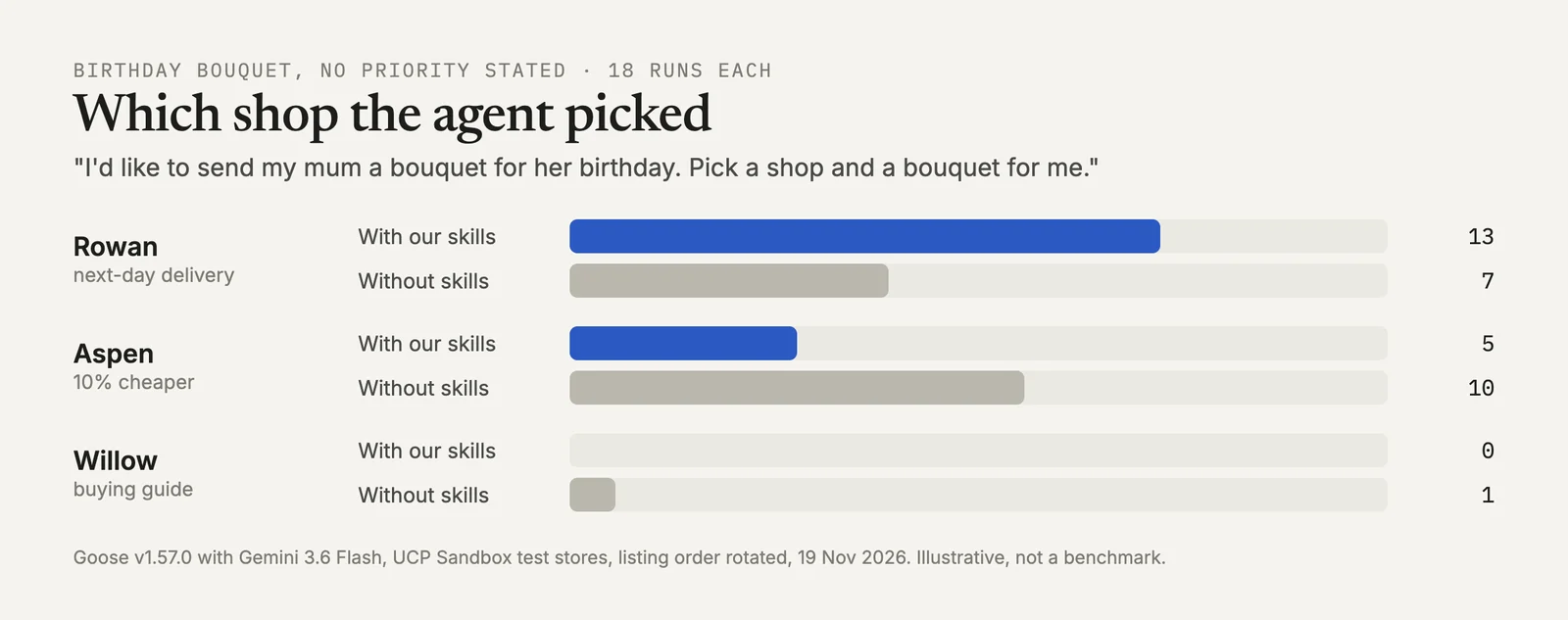
The open birthday task, 18 runs each. With our skills the agent read "for her birthday" as a date to meet; without them it leaned to the lower price.
Every answer gave the real difference as its reason (the price or the next-day delivery), and no run opened a cart or a checkout.
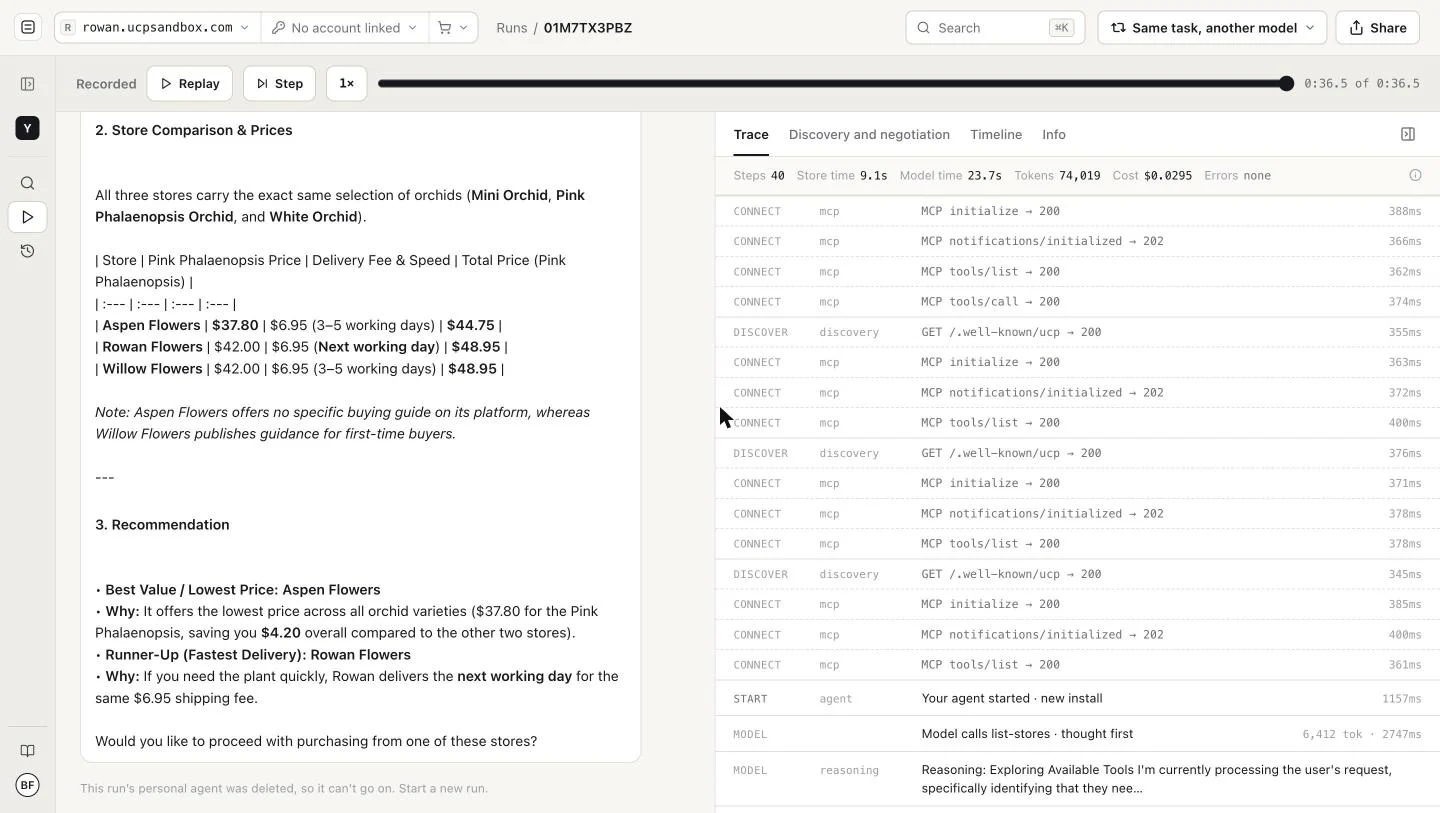
A typical answer: the three stores side by side, Willow's guide noted, the cheaper store recommended and the faster one as runner-up.
Where the skills made a difference
Reading the buyer's need. On the birthday task, our buyer-compare skill tells the agent to read the buyer's priority from the request. With it, the agent inferred one: a birthday has a date. In 13 of 18 runs it chose next-day Rowan, usually naming Aspen as the cheaper runner-up. Without skills, the agent leaned to the lower price: 10 of 18 runs chose Aspen.
Saying whose advice it is. On the orchid task, our buyer-research skill tells the agent to label its own knowledge. With it, 13 of 18 answers said the criteria were general advice rather than the store's. Without it, none did.
Where they didn't
The guide never won. On the orchid task, every agent compared all three stores and went to the cheaper one, with skills or without. Willow's guide was read in only a handful of runs: an agent has to connect to a store before it can ask it anything, and most connected to one store, if any. Our buyer-compare skill says to ask each store in turn; in 18 runs, the agent asked more than one store only three times.
Totals. Including delivery in the total for the cheapest roses was no more common with our skills than without.
Tokens. The skills cost more on the open-ended tasks (a middle run of 62,000 tokens against 51,000 on the orchid task, 53,000 against 45,000 on the birthday task) and less on the tomorrow task (37,000 against 43,000).
What it means for stores
- Make your advantage visible where agents read. Price shows in search; delivery shows in your listing and policies. Agents found both every time.
- A buying guide doesn't win against a visible price gap on its own. If you compete on advice, publish it where agents look (your policies, and your answers through Ask), and expect price to be read first.
- Listing order is not a strategy. Once it was rotated, the store's own data decided.
What it means for agent builders
- Skills change judgment, not facts. When the data is plain, a capable model finds it without help. Skills earn their place where the buyer leaves something unsaid, and in how the agent explains itself.
- Instructions to visit every store are not followed by default. If comparison across stores matters, the agent's tools or loop have to make it easy.
- Test with skills off as well as on. Several of our skills made no measurable difference.
Limits
One agent (Goose) and one model (Gemini 3.6 Flash), on our own test stores, on one day. 18 runs per task in the three-store test is enough to show large differences, not small ones. The results hold for these amounts: 10% cheaper, next-day against 3 to 5 days. Our own skills were tested by us; the skills, tasks and checks were fixed before the runs, and every run is recorded.
FAQ
What are buyer-side shopping skills?
Instruction files for an AI agent that shops on a person's behalf. They tell it how to search, compare stores, research a category, plan purchases, use what it remembers about the buyer, and handle problems after a sale, from the buyer's side.
Do shopping skills help an AI agent choose a store?
When stores differ in a way the data shows plainly, such as price or delivery time, agents chose correctly with or without skills in our tests. Skills changed the choice when the buyer didn't state a priority, and changed how the agent explained its choice.
Does listing order affect which store an AI agent picks?
It did when the order was fixed: in an earlier test, the store listed first won 37 of 40 times. When we rotated the order, the first-listed store won about a third of the time, as chance would predict.
Do AI agents value a store's buying guide?
Not against a lower price in our tests. No agent chose the store with a buying guide over a store that was 10% cheaper, even when the buyer asked how to choose.
How are buyer-side skills different from Anthropic's shopping skills?
Anthropic's skills in commerce-agents are written for a store's own assistant inside its app. Ours follow the same five flows for an agent that works for the buyer and reaches stores from outside, and add a skill for choosing between stores.
Can I use these skills?
Yes. They're licensed Apache-2.0, so you can use and change them with credit. Every new personal agent in UCP Playground starts with them, each can be switched off, and you can download them, licence included, from the agent's files.
Which agent and model did you test?
Goose v1.57.0 with Gemini 3.6 Flash, as fresh personal agents in UCP Playground, on 19 November 2026.
About UCP Checker
UCP Checker is the independent validation and observability layer for the Universal Commerce Protocol. We crawl, validate and grade every public UCP manifest we can find, run the merchant directory, the UCP Score, live adoption stats, the vertical guides and the authority-bound vendor map, and track the spec as it evolves so you don't have to — measured from two vantages (what a business declares, and what actually happens when an agent transacts), the same way for everyone, without picking winners.
Sources
- commerce-agents. Anthropic, Apache-2.0; the five shopping-agent skills our five follow.
- Goose. Open-source agent, Apache-2.0; v1.57.0 in these runs.
- Personal agents. UCP Playground docs.
- Recorded runs, UCP Playground, Goose v1.57.0 with Gemini 3.6 Flash, 19 November 2026:
- First orchid, one store, with our skills: says the store has no guide and labels its advice
- First orchid, one store, without skills: "Orchids Available in Our Shop"
- First orchid, three stores, with our skills: asks each store, then compares
- Birthday bouquet, three stores, with our skills: picks next-day Rowan
- Birthday bouquet, three stores, without skills: picks the cheaper Aspen
Related coverage: UCP Playground now runs personal agents · How UCP's Ask works, step by step · How UCP works: a real agent buys flowers