
Checkout ends when the store says completed. For the buyer, that's when the waiting starts: has it shipped, where is it, did the refund go through. In UCP those answers live in the Order capability, dev.ucp.shopping.order. It gives an agent one object to read, a log of what happened to the parcel, and a signed webhook that tells the agent when anything changes.
This guide follows an order on our UCP Sandbox flower shop, from the moment checkout completes to delivery: the order object, its line statuses, the store's promise about delivery, the events as they happen, the webhooks the store sends, and the scopes a store can put on reading an order. The rules come from the 2026-08-25 release. We also note the changes on main since then, and the proposals that would change orders next.
What is the UCP Order capability?
The UCP Order capability (dev.ucp.shopping.order) is the record of a placed order: what was bought, how it will reach the buyer, and everything that has happened since. The spec puts it in one line:
Orders represent confirmed transactions resulting from a successful checkout submission.
An order has three parts:
- Line items: what was bought, with
quantity.original,quantity.totalandquantity.fulfilled, and astatusderived from them. - Fulfillment:
expectations[], the store's promise about how and when items arrive, andevents[], an append-only log of what actually happened. - Adjustments: refunds, returns, credits, disputes and cancellations, recorded on their own, whatever the delivery is doing.
The rules that matter most, quoted from the spec:
- Full state, every time. "Businesses MUST return the full order entity on every response." Webhooks carry the same full snapshot: the business "MUST send full order entity on updates (not incremental deltas)".
- Line items are never dropped. Line items "MUST include all line items that ever existed on the order regardless of edits or alterations".
- Reads are authenticated. "The business MUST authenticate requests to order data before returning a response".
- Webhooks are signed and retried. The business "MUST sign all webhook payloads", "MUST send 'Order created' event with fully populated order entity" and "MUST retry failed webhook deliveries".
- The platform checks who sent it. After verifying the signature, "the platform MUST confirm the signer is authorized to send events for the referenced order".
- Webhooks first, reads to reconcile. The platform "SHOULD rely on webhooks … as the primary order update channel and use Get Order for reconciliation or on-demand retrieval", and "SHOULD treat order data as ephemeral".
- Adjustments are a ledger. Businesses "SHOULD append new entries rather than mutating existing ones".
There is one operation, Get Order (GET /orders/{id} over REST, get_order over MCP), and one event, the Order Event Webhook. There is no cancel or return call in the release: the spec names the order's permalink_url as "the authoritative reference for the full order experience - timeline, post-purchase operations, returns".
What changed since 2026-08-25
The order capability in the 2026-08-25 release is what stores declare today. Two changes have merged to main since, and are not yet in a release:
| 2026-08-25 release | main (not yet released) |
|
|---|---|---|
| Webhook signature | Covers method, authority, path, content-digest, content-type (per the example) |
Must also cover Webhook-Id and Webhook-Timestamp; platforms reject a delivery that doesn't (the example now covers ucp-agent too) (#659, merged 16 October 2026) |
| Retries | "MUST retry failed webhook deliveries" | Also "MUST send retries with the original Webhook-Id and Webhook-Timestamp"; platforms "SHOULD deduplicate on Webhook-Id" |
| List price | Not on orders | Businesses MAY keep a snapshot of the checkout's item.list_price on order lines (#1016, merged 9 November 2026, planned for 2026-12-08) |
The 2026-12-08 release is a plan that can move. Everything else in this guide is in the 2026-08-25 release and unchanged on main.
The setup
| Host | What it shows |
|---|---|
| flowers.ucpsandbox.com | A 110-product flower shop that declares dev.ucp.shopping.order. Nothing ships: an order moves on a timer, shipped ten minutes after it's placed and delivered after thirty, so a later read shows real fulfillment events. It also keeps a fixed test order, NF-RELY01, that's always out for delivery. It sends signed order webhooks to the platform's webhook_url. |
| flowers-account.ucpsandbox.com | The same shop, where reading an order needs a linked buyer account with dev.ucp.shopping.order:read. |
On the other side is UCP Playground, whose own UCP profile gives the store a webhook address and records every delivery it receives.
Tested with: 25 November 2026, 14:28–15:46 UTC · UCP 2026-08-25 (the stores' declared release) · UCP Sandbox 0.32.0 (flowers.ucpsandbox.com, flowers-account.ucpsandbox.com) · UCP Playground 0.24.235 · agent run: Gemini 3.6 Flash (
gemini-3-6-flash)
Step 1: both profiles declare orders
The store declares the capability. The platform declares it too, and puts the address it wants order events sent to in config.webhook_url. That's how the store learns where to send them: "The business discovers this URL from the platform's profile".
"dev.ucp.shopping.order": [{
  "version": "2026-08-25",
  "spec": "https://ucp.dev/2026-08-25/specification/shopping/order",
  "schema": "https://ucp.dev/2026-08-25/schemas/shopping/order.json",
  "config": { "webhook_url": "https://ucpplayground.com/webhooks/ucp/orders" }
}]
That's the entry in Playground's agent profile (/.well-known/ucp-agent). The store's is the same without config. With both declared, order is one of the capabilities the two sides agree on.
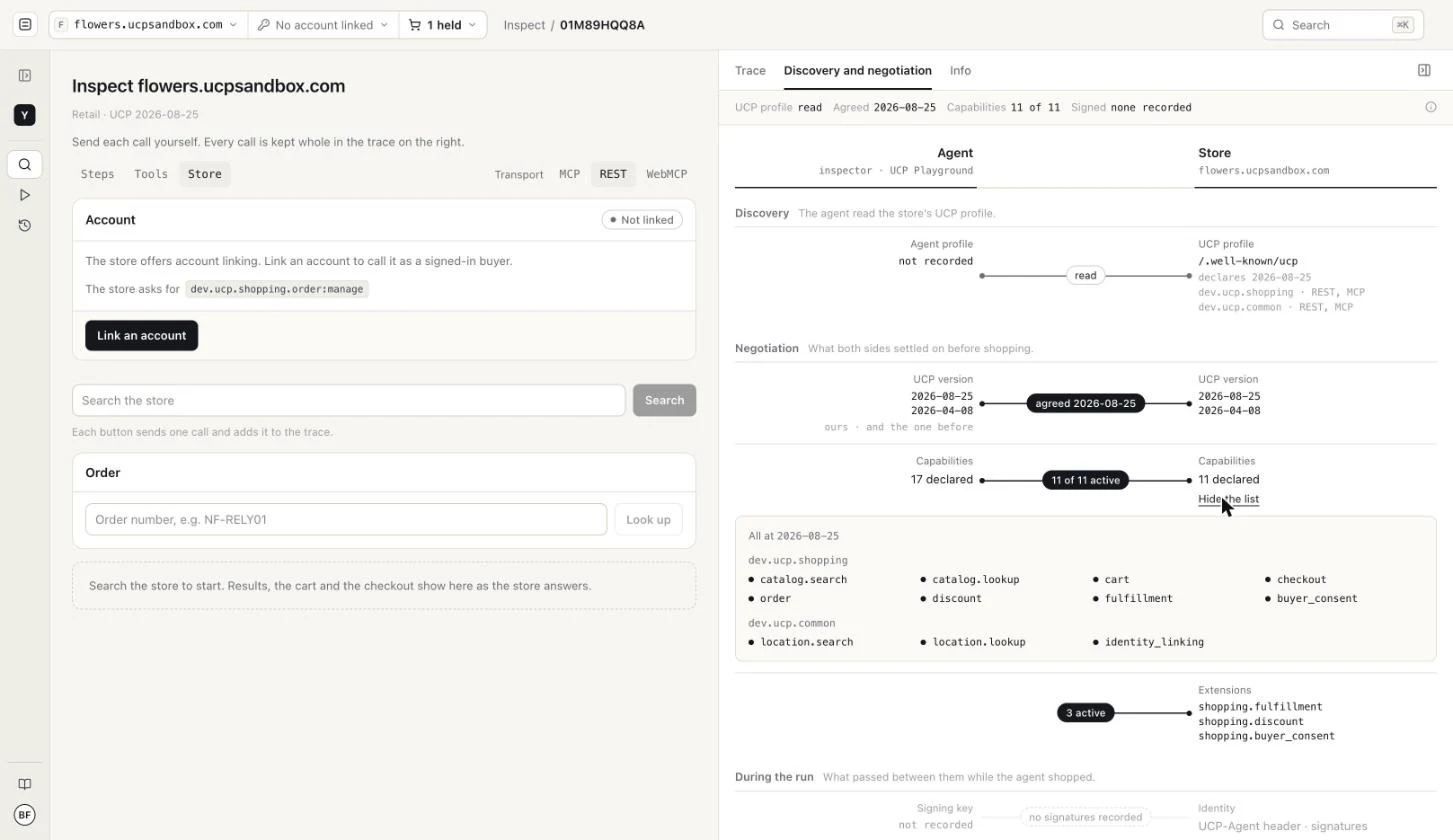 Inspect on flowers.ucpsandbox.com: the agreed version and the eleven capabilities both sides use, order among them.
Tested with: 25 November 2026, 14:28 UTC · UCP 2026-08-25 · UCP Sandbox 0.32.0 (flowers.ucpsandbox.com) · UCP Playground 0.24.235 · Inspect, REST
Step 2: checkout completes and hands over an order
When Complete Checkout finishes, the checkout's status is completed and it carries an order with "necessary identifiers such as id and permalink_url". The Sandbox adds the order's short label, which the spec says "MUST only be provided by the business":
"status": "completed",
"order": {
  "id": "01a2131d-bab8-7347-b457-d6350e51fe39",
  "label": "NF-J83TPV",
  "permalink_url": "https://flowers.ucpsandbox.com/orders/01a2131d-bab8-7347-b457-d6350e51fe39"
}
If the store takes payment in the background, the status is complete_in_progress instead, and "The response MUST NOT contain order". The order arrives later, on a read of the checkout or by webhook.
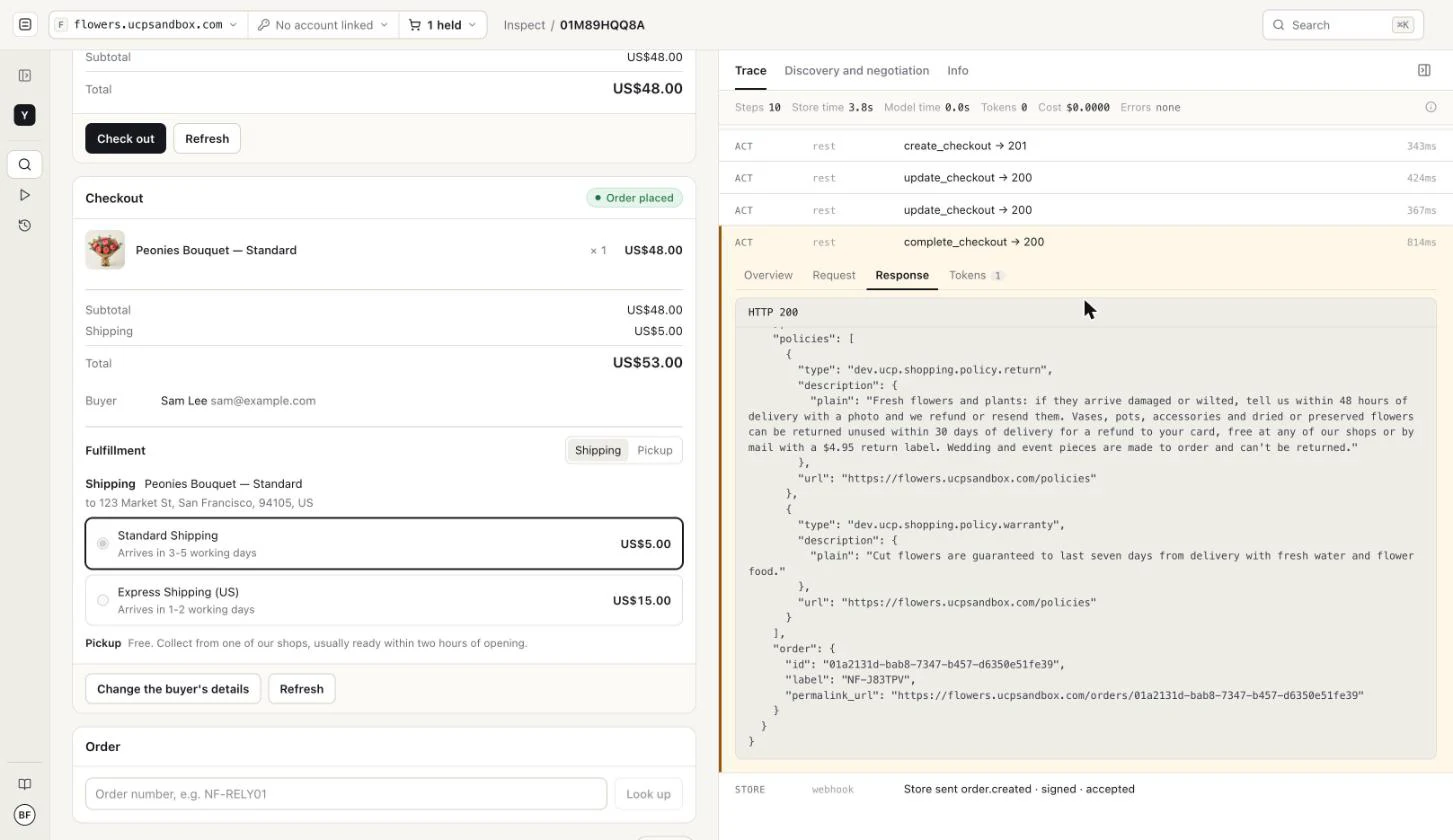 One Standard peony bouquet with Standard Shipping, $53.00. The reply ends with the order's id, label and permalink_url, and the next trace line is the store's order.created webhook.
Tested with: 25 November 2026, 14:31 UTC · UCP 2026-08-25 · UCP Sandbox 0.32.0 (flowers.ucpsandbox.com) · UCP Playground 0.24.235 · Inspect, REST
Step 3: the order on the first read
Read the order straight away and the store returns the whole entity. The line has fulfilled: 0, so its status is processing. The store's promise is one expectation built from the checkout: the method, the address and the option the buyer chose. There are no events yet.
"line_items": [{
  "id": "li_34607",
  "item": { "id": "bouquet_peonies", "title": "Peonies Bouquet — Standard", "price": 4800 },
  "quantity": { "original": 1, "total": 1, "fulfilled": 0 },
  "status": "processing"
}],
"fulfillment": {
  "expectations": [{
    "id": "exp_1",
    "line_items": [{ "id": "li_34607", "quantity": 1 }],
    "method_type": "shipping",
    "destination": { "street_address": "123 Market St", "address_locality": "San Francisco", "address_region": "CA", "postal_code": "94105", "address_country": "US" },
    "description": "Standard Shipping",
    "fulfillable_on": "now"
  }],
  "events": []
}
The line status is never set by hand. The spec derives it from the counts: removed if total is 0, fulfilled when fulfilled equals total, partial when some are fulfilled, otherwise processing.
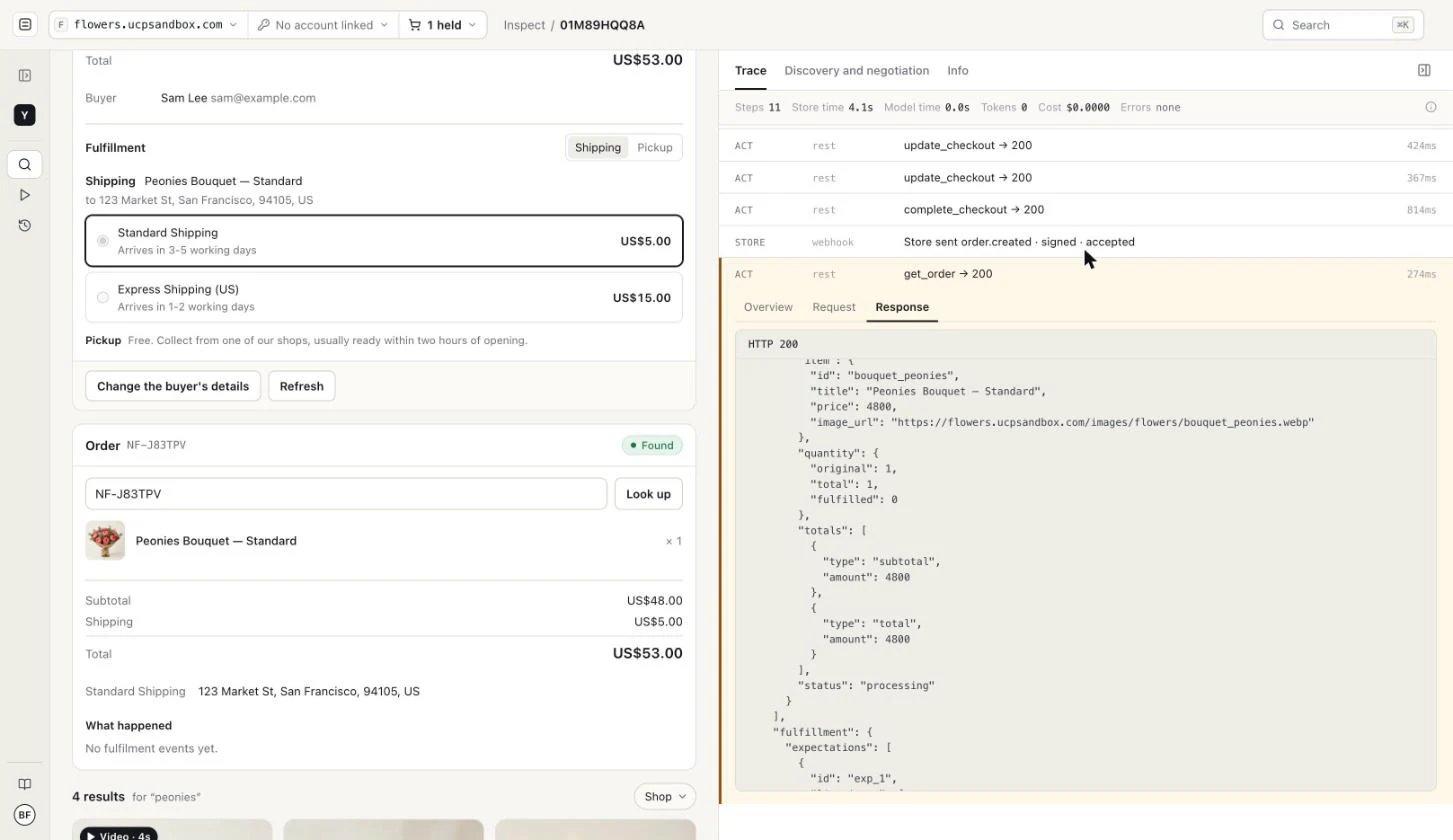 Looked up straight after checkout: the line is processing and "What happened" is empty.
Tested with: 25 November 2026, 14:31 UTC · UCP 2026-08-25 · UCP Sandbox 0.32.0 (flowers.ucpsandbox.com) · UCP Playground 0.24.235 · Inspect, REST
Step 4: shipped
The Sandbox moves an order on a timer: shipped ten minutes after it was placed, delivered after thirty. Here is the store's fixed test order NF-RELY01, which is always somewhere between the two. The events log has one entry. The expectation hasn't changed: it's still the promise, and the event is what happened.
"events": [{
  "id": "evt_msum9iijnh",
  "type": "shipped",
  "line_items": [{ "id": "li_34656", "quantity": 1 }],
  "description": "Out for delivery with Sandbox Post.",
  "occurred_at": "2026-11-25T15:40:02+00:00",
  "tracking_url": "https://flowers.ucpsandbox.com/orders/01a21361-bedc-7125-be98-1c58c3b8a5f1"
}]
This store counts an item as fulfilled once it has shipped, so the line now reads fulfilled: 1 of total: 1 and its status is fulfilled. Event type is an open string in the release. The spec lists common values (processing, shipped, in_transit, delivered, failed_attempt, canceled, undeliverable, returned_to_sender), and each event names the lines and quantities it covers, so a split shipment is two events.
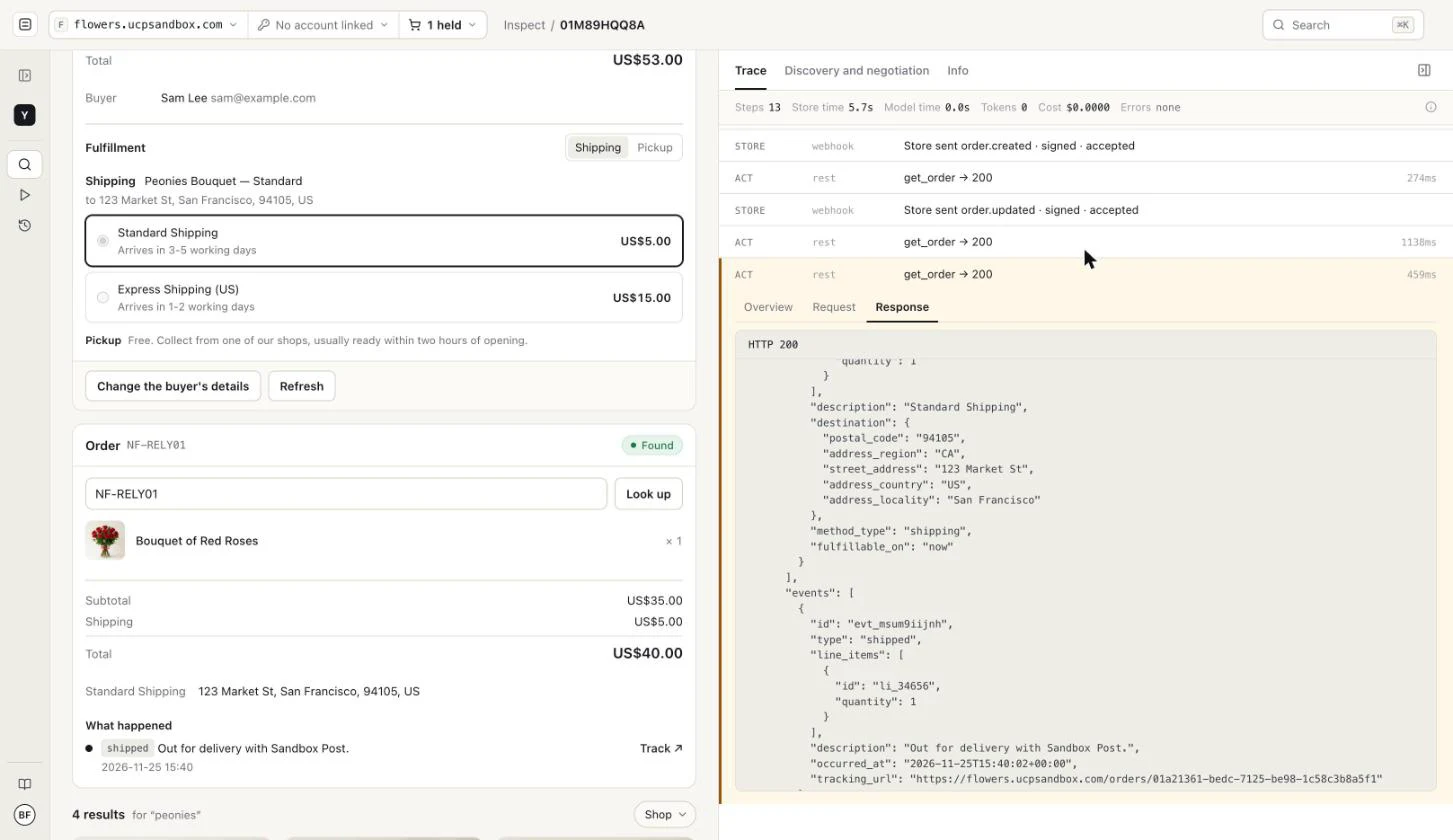 The Sandbox's fixed test order NF-RELY01, read while it's out for delivery: one shipped event, and the expectation unchanged.
Tested with: 25 November 2026, 15:46 UTC · UCP 2026-08-25 · UCP Sandbox 0.32.0 (flowers.ucpsandbox.com) · UCP Playground 0.24.235 · Inspect, REST
Step 5: delivered
Back to our own order, NF-J83TPV, read again after the thirty minutes had passed. A delivered event now follows the shipped one, which stays exactly as it was. That's the append-only log. The totals still show what was paid, including delivery:
"events": [
  { "id": "evt_hvk3w2zmoa", "type": "shipped", "description": "Out for delivery with Sandbox Post.", "occurred_at": "2026-11-25T14:40:45+00:00", … },
  { "id": "evt_kzry3toq7d", "type": "delivered", "description": "Delivered.", "occurred_at": "2026-11-25T15:00:45+00:00", … }
],
…
"totals": [
  { "type": "subtotal", "amount": 4800 },
  { "type": "fulfillment", "amount": 500, "display_text": "Shipping" },
  { "type": "total", "amount": 5300 }
]
If something were refunded, it would appear in adjustments[] with a signed amount (negative for money back to the buyer) and a status of pending, completed or failed. The delivered order has none, so adjustments is empty.
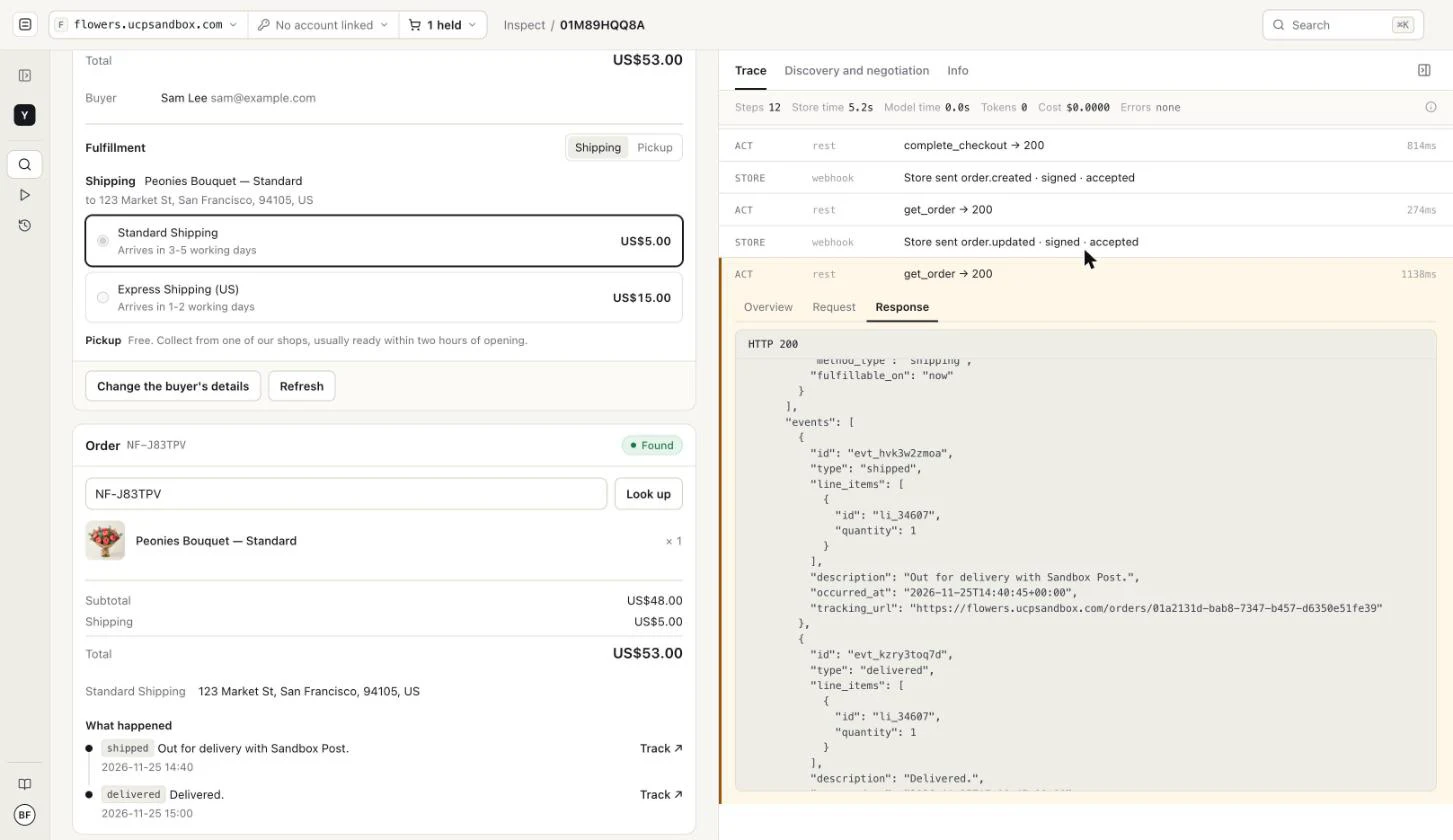 Our order after delivery: two events, oldest first. Above them in the trace, the store's order.updated webhook.
Tested with: 25 November 2026, 15:45 UTC · UCP 2026-08-25 · UCP Sandbox 0.32.0 (flowers.ucpsandbox.com) · UCP Playground 0.24.235 · Inspect, REST
Step 6: the webhooks the store sent
Nobody had to ask. When the order was placed and again when it moved on, the store POSTed the full order to Playground's webhook_url, signed with a key from its own profile. Playground's trace shows each delivery as its webhook receiver recorded it: the event, whether the signature verified, and whether the signer is the store the order was placed with. That last check is the platform's MUST on ownership.
The release's required headers are Webhook-Id and Webhook-Timestamp, plus UCP-Agent, Signature-Input, Signature and Content-Digest for the signature. The body is the order. The Sandbox also puts an event_id and a type (order.created, order.updated) next to it, as the 2026-08-25 example body carried an event_id; main's example body is the order alone.
A platform needs two things to make this reliable. The release requires the first: answer quickly with a 2xx and do the work afterwards. main adds the second: treat a repeated Webhook-Id as the same event.
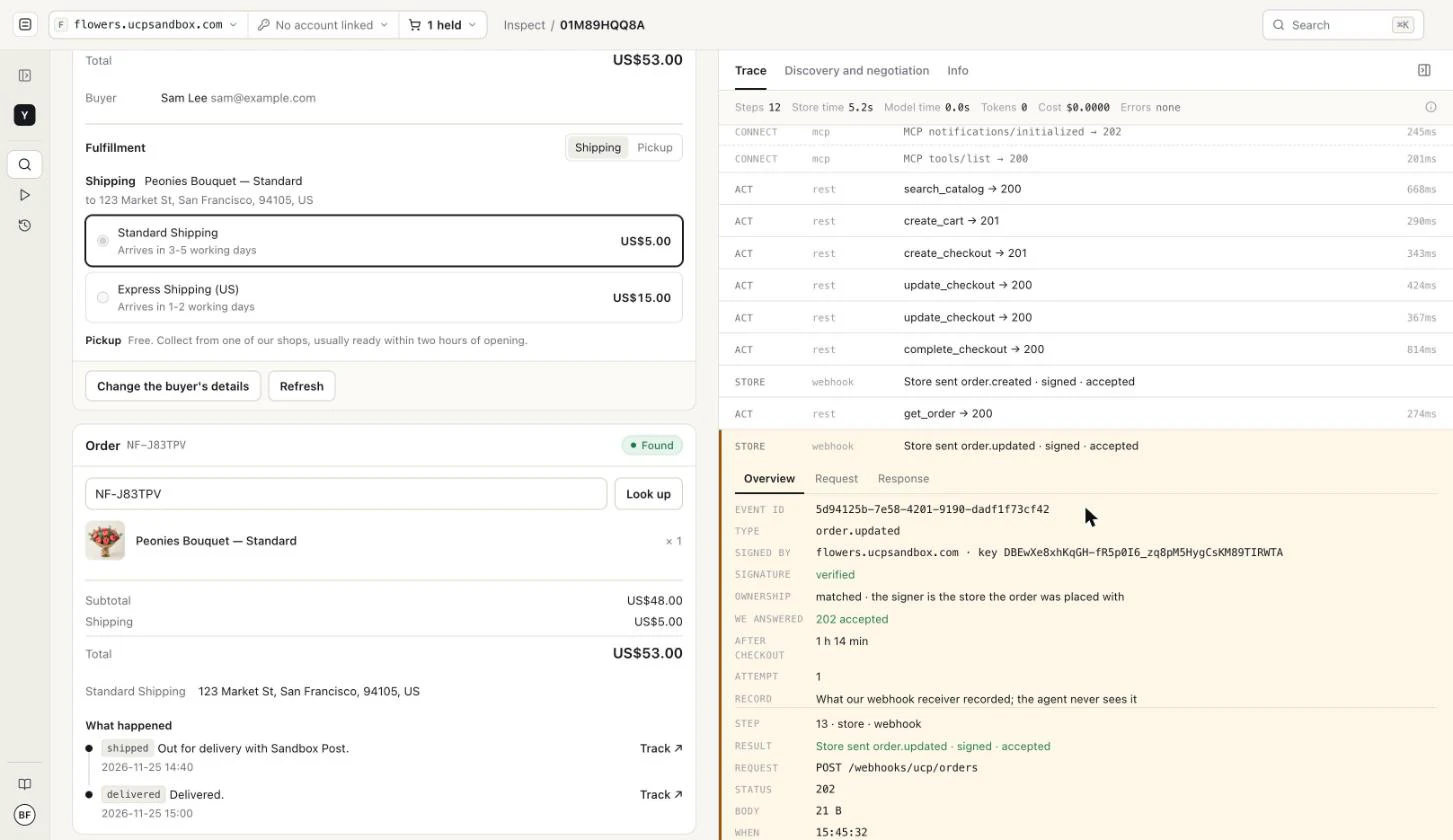 Two signed deliveries for NF-J83TPV. The open one is order.updated: signed by flowers.ucpsandbox.com, signature verified, ownership matched, answered 202.
Tested with: 25 November 2026, 14:31–15:45 UTC · UCP 2026-08-25 · UCP Sandbox 0.32.0 (flowers.ucpsandbox.com) · UCP Playground 0.24.235 · Inspect, REST
Step 7: scopes, when the store wants a signed-in buyer
The spec defines two scopes for reading and managing a buyer's orders over identity linking:
| Scope | What it grants (the spec's words) |
|---|---|
dev.ucp.shopping.order:read |
"Read access to the user's orders — Get Order on resources owned by the authenticated user." |
dev.ucp.shopping.order:manage |
"Post-purchase operations on the user's orders — cancellation, returns, and other modifications." |
The authentication used decides which orders a caller can see. With platform credentials, a business "MAY allow access for orders the platform originated". With buyer authorization, the platform reaches "the buyer's orders regardless of which platform originated them".
On flowers-account, a read with no linked buyer is refused before the store looks for the order:
{ "type": "error", "code": "identity_required", "severity": "requires_buyer_review",
  "content": "Sign in to your Northlight Flowers account to see your orders: this needs a linked buyer account." }
It comes back as HTTP 401, with a WWW-Authenticate header that points at the store's protected-resource metadata, where account linking starts.
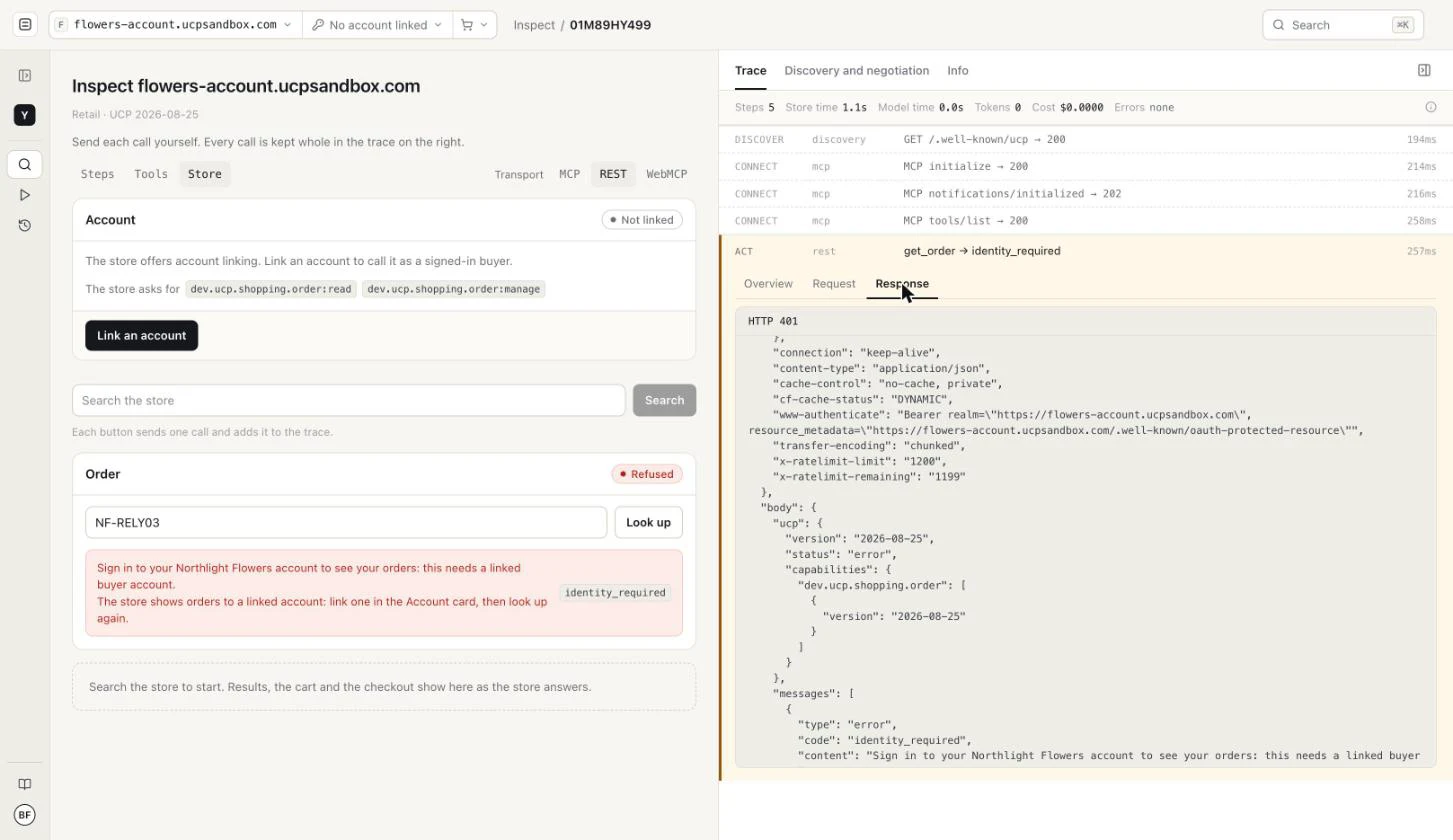 No linked account, so the lookup is refused. The reply shows the 401, the WWW-Authenticate header and the store's message.
Tested with: 25 November 2026, 14:32 UTC · UCP 2026-08-25 · UCP Sandbox 0.32.0 (flowers-account.ucpsandbox.com) · UCP Playground 0.24.235 · Inspect, REST
An agent asks about its order
We gave one agent a task that ends in an order and asks about it straight away:
"Buy one Standard Peonies Bouquet from this shop, delivered to 123 Market St, San Francisco, CA 94105, with the cheapest delivery, and pay with the test card. Then tell me the order number, where I can follow it, and when it should arrive. After that, check the order again and tell me its status."
We wrote five checks before the run, read from its answer and its trace:
| Check | Result |
|---|---|
One order placed (one complete_checkout, checkout completed) |
Yes: order NF-FRQTGF |
The order number is the store's label, and the place to follow it is the store's order page |
Partly: it gave NF-FRQTGF and pointed to "the store's order tracking page", but not the page's address. The run's order card links to it from permalink_url. |
Read the order back with get_order, not from memory |
Yes |
| Status and timing in the store's words, nothing invented | Yes: "3 to 5 working days via Standard Shipping", status processing, no tracking number made up |
| Stated total matches the order's | Yes: $53.00 ($48.00 plus $5.00 delivery) |
The trace also shows the store's order.created webhook arriving between the checkout and the agent's get_order, signed and accepted. The agent never sees it. Webhooks go to the platform, so it's up to the platform to pass them on, for example by telling the buyer when the bouquet ships.
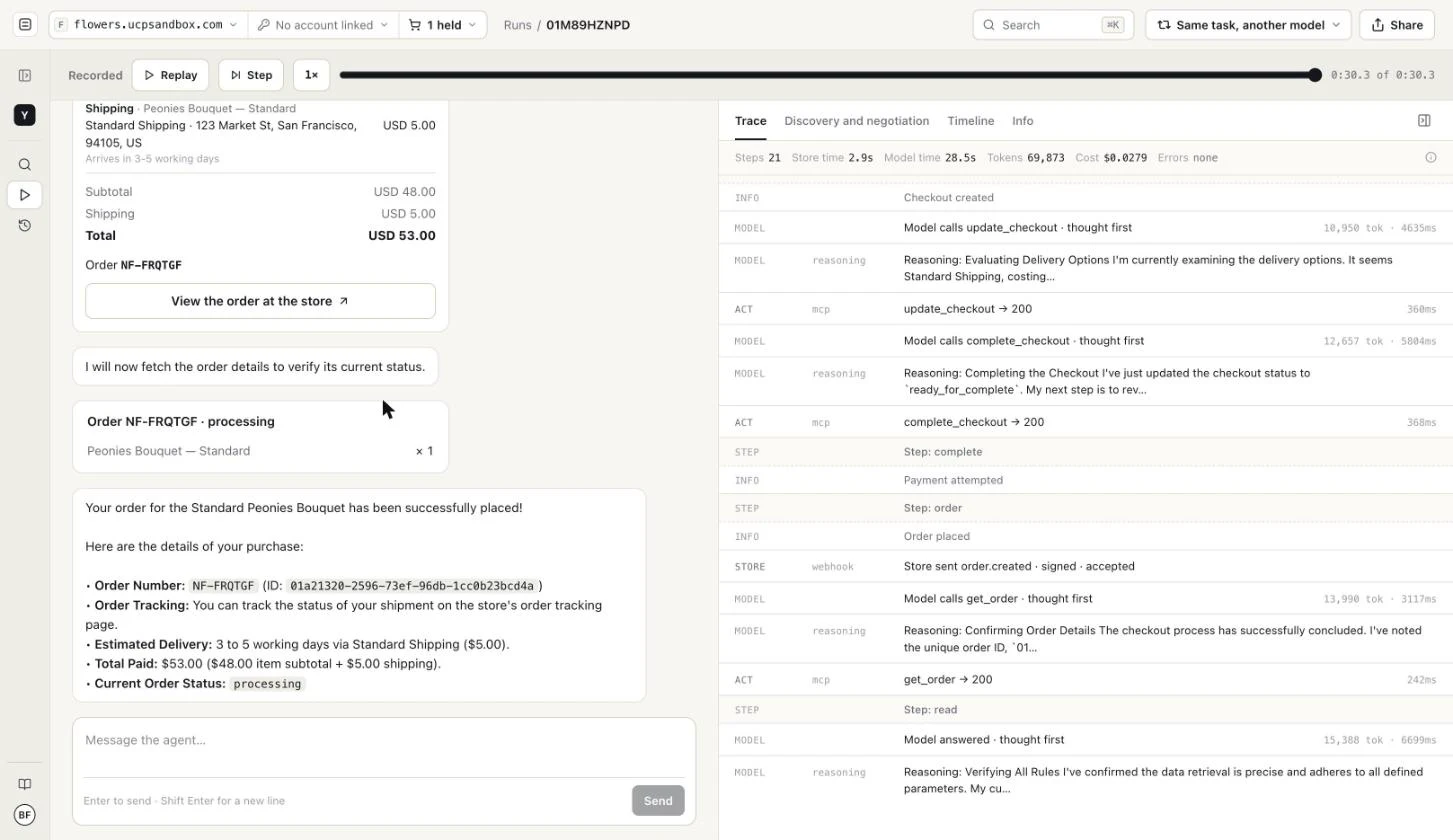 Gemini 3.6 Flash on flowers.ucpsandbox.com: one order, one read back, and the answer. Beside it, the store's order.created webhook in the trace.
Open the run with the full trace. One run with one model is an illustration, not a measure of how agents handle orders.
Tested with: 25 November 2026, 14:33 UTC · UCP 2026-08-25 · UCP Sandbox 0.32.0 (flowers.ucpsandbox.com) · UCP Playground 0.24.235 · Gemini 3.6 Flash (
gemini-3-6-flash), one run. Illustrative, not a benchmark.
What it means for stores
- Send the full order on every read and every webhook, and keep every line that was ever on it, even at
total: 0. - Keep the promise and the facts apart: update
expectationswhen the plan changes, and appendeventsas things happen. Write event descriptions a buyer can read as they are. - Sign every webhook, retry failures with the same
Webhook-IdandWebhook-Timestamp, and cover both in the signature, asmainnow requires.
What it means for agent builders
- Put a
webhook_urlin your profile's order entry, verify each delivery's signature against the store's profile keys, and check the order is one you placed with that store. - Use Get Order to reconcile, not to poll on a timer, and don't keep order data longer than the conversation needs it.
- Tell the buyer what the order says: the expectation's description for "when", the latest event for "where is it", and the
permalink_urlfor anything the API doesn't cover, such as returns.
What we'll watch
Several open proposals would change orders next:
- Event types. #979 proposes five well-known event types (
processing,shipped,in_transit,delivered,canceled), with a required description for any other type. It's planned for the 2026-12-08 release, a plan that can move. - Guest access. #848 proposes an order credential issued at completion, so a guest buyer with no account can be given a route back to their order. Also planned for 2026-12-08.
- Which shop. #1152, opened on 24 November, proposes a
business_locationon fulfillment expectations, so a pickup order keeps the shop's id and name and not only its address. - Discounts and sellers on the order. #1089 proposes keeping the applied discount codes on the order, and #1018 adds seller attribution to cart, checkout and order (planned for 2026-12-08).
- After the sale. #843 proposes standard adjustment types, #945 a cancellation extension, and #544 a returns capability.
- Webhooks beyond REST. #865 asks how order events should reach an MCP-only platform, and the RFC #938 proposes webhooks for other capabilities.
Follow every open proposal on the Changes to UCP tracker.
FAQ
What is the UCP Order capability?
dev.ucp.shopping.order is the record of a placed order in UCP: its line items with quantities and status, the store's delivery promise (expectations), what actually happened (events), and refunds or returns (adjustments). An agent reads it with Get Order and receives changes by webhook.
How does an AI agent track an order in UCP?
The store sends the full order to the agent platform's webhook_url whenever it changes, signed with a key from the store's profile. The agent can also read it on demand with GET /orders/{id} or the get_order tool. Either way it gets the whole current state, not a delta.
What order statuses does UCP have?
Each line item has a derived status: processing, partial, fulfilled or removed, worked out from quantity.total and quantity.fulfilled. Delivery stages such as shipped and delivered are fulfillment event types, which are open strings in the 2026-08-25 release. #979 proposes five well-known ones.
What is the difference between a fulfillment expectation and a fulfillment event?
An expectation is the store's current promise to the buyer: which items, by which method, to where, and when. It can be split, merged or changed. An event is a fact that happened, such as "shipped", and is only ever appended.
Can an AI agent cancel or return an order over UCP?
Not in the 2026-08-25 release. The only operation is Get Order. The spec defines the dev.ucp.shopping.order:manage scope for cancellation and returns, and points to the order's permalink_url for post-purchase operations. Cancellation and returns capabilities are open proposals.
Do UCP order webhooks need to be signed?
Yes. The business must sign every webhook per RFC 9421, with Content-Digest, Signature-Input and Signature headers, and the platform must verify it against the keys in the store's UCP profile. On main, the signature must also cover Webhook-Id and Webhook-Timestamp.
Which release has the UCP Order capability?
Orders have been in UCP since its first release in January 2026. The webhook replay rules and order list price are on main, not yet released; list price is planned for the 2026-12-08 release.
Where can I try UCP orders?
Open flowers.ucpsandbox.com in UCP Playground Inspect, place a test order, and look it up again after ten and thirty minutes.
About UCP Checker
UCP Checker is the independent validation and observability layer for the Universal Commerce Protocol. We crawl, validate and grade every public UCP manifest we can find, run the merchant directory, the UCP Score, live adoption stats, the vertical guides and the authority-bound vendor map, and track the spec as it evolves so you don't have to — measured from two vantages (what a business declares, and what actually happens when an agent transacts), the same way for everyone, without picking winners.
Sources
-
The agent run. UCP Playground, Gemini 3.6 Flash, 25 November 2026.
-
Order capability. UCP specification, 2026-08-25 release.
-
Order capability on
main. UCP spec repository, read 25 November 2026. -
PR #659: cover webhook-id and webhook-timestamp in the signing gate. Merged 16 October 2026, not yet in a release.
-
PR #1016: response-only list_price on items. Merged 9 November 2026, milestone 2026-12-08.
-
PR #979: standardize fulfillment event types. Open, milestone 2026-12-08.
-
PR #848: order access credentials for guest post-purchase access. Open, milestone 2026-12-08.
-
PR #1018: seller attribution on cart, checkout and order. Open, milestone 2026-12-08.
-
PR #1152: business_location on fulfillment expectations. Open, opened 24 November 2026.
-
PR #843: standard adjustment types. Open, milestone 2027-03-30.
-
PR #945: cancellation-first order modification extension. Open.
-
Issue #544: post-purchase returns, exchanges and claims. Open, milestone 2027-03-30.
-
PR #938: capability event webhooks RFC. Open, milestone 2027-03-30.
Related coverage: UCP fulfillment explained, step by step · How UCP works: a real agent buys flowers · UCP discount codes explained, step by step · UCP webhooks and verified order events