
The State of Agentic Commerce — March 2026

On February 13th we published our first State of Agentic Commerce report. We'd scanned 1,000 Shopify stores, found universal UCP adoption on the platform, and zero manifests anywhere else.
A month later, the picture has changed — meaningfully. We're now tracking over 3,000 domains, non-Shopify platforms are showing up in our benchmarks for the first time, and the UCP spec is evolving fast with returns, loyalty, and fees landing in the working draft. Here's what the data shows.
The numbers
- 3,034 domains tracked (up from ~2,000 in late February)
- 2,646 verified — live, valid UCP manifests (87% of pool)
- 1,183 stores benchmarked with full capability audits
- 285 "generic" platforms appearing in benchmarks — the first non-Shopify entries
- ~189 PRs filed on the UCP spec repo (42 open, 147 closed)
- 2,500 GitHub stars, 304 forks
The headline: UCP adoption has tripled in a month.
Growth trajectory
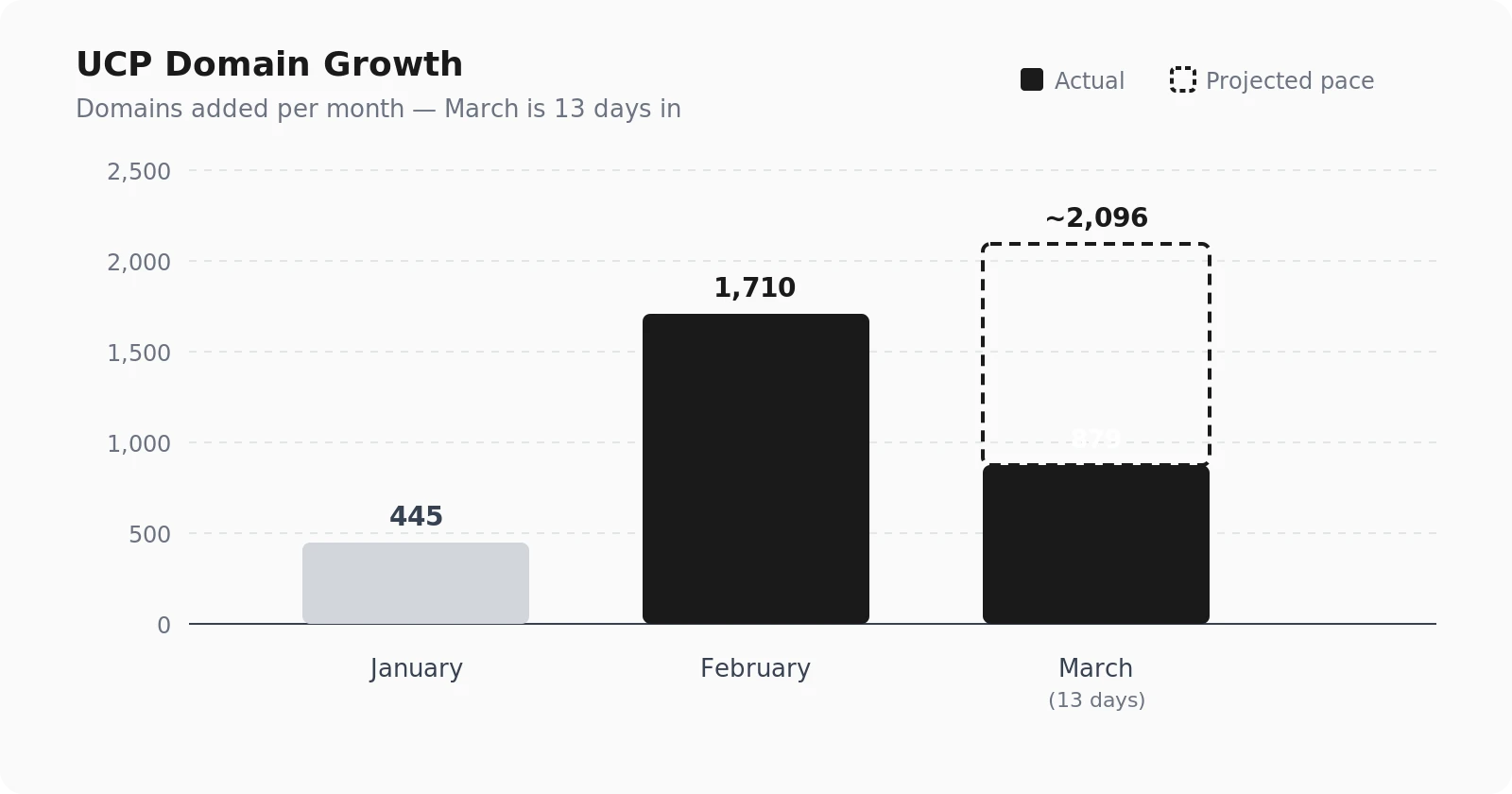
Our monitoring pool has grown from roughly 450 domains in January to over 3,000 in mid-March. But the shape of that growth is telling.
| Month | Domains added | Verified |
|---|---|---|
| January | 445 | 187 (42%) |
| February | 1,710 | 1,625 (95%) |
| March (13 days) | 879 | 834 (95%) |
January was mostly our initial crawl of known Shopify stores, which is why the verified rate was lower — we were casting a wide net. By February, discovery channels like the Chrome extension and bulk-check submissions were feeding in domains that were overwhelmingly real merchants with live manifests. That 95% verified rate has held into March.
At the current pace, we'll cross 4,000 tracked domains by month-end.
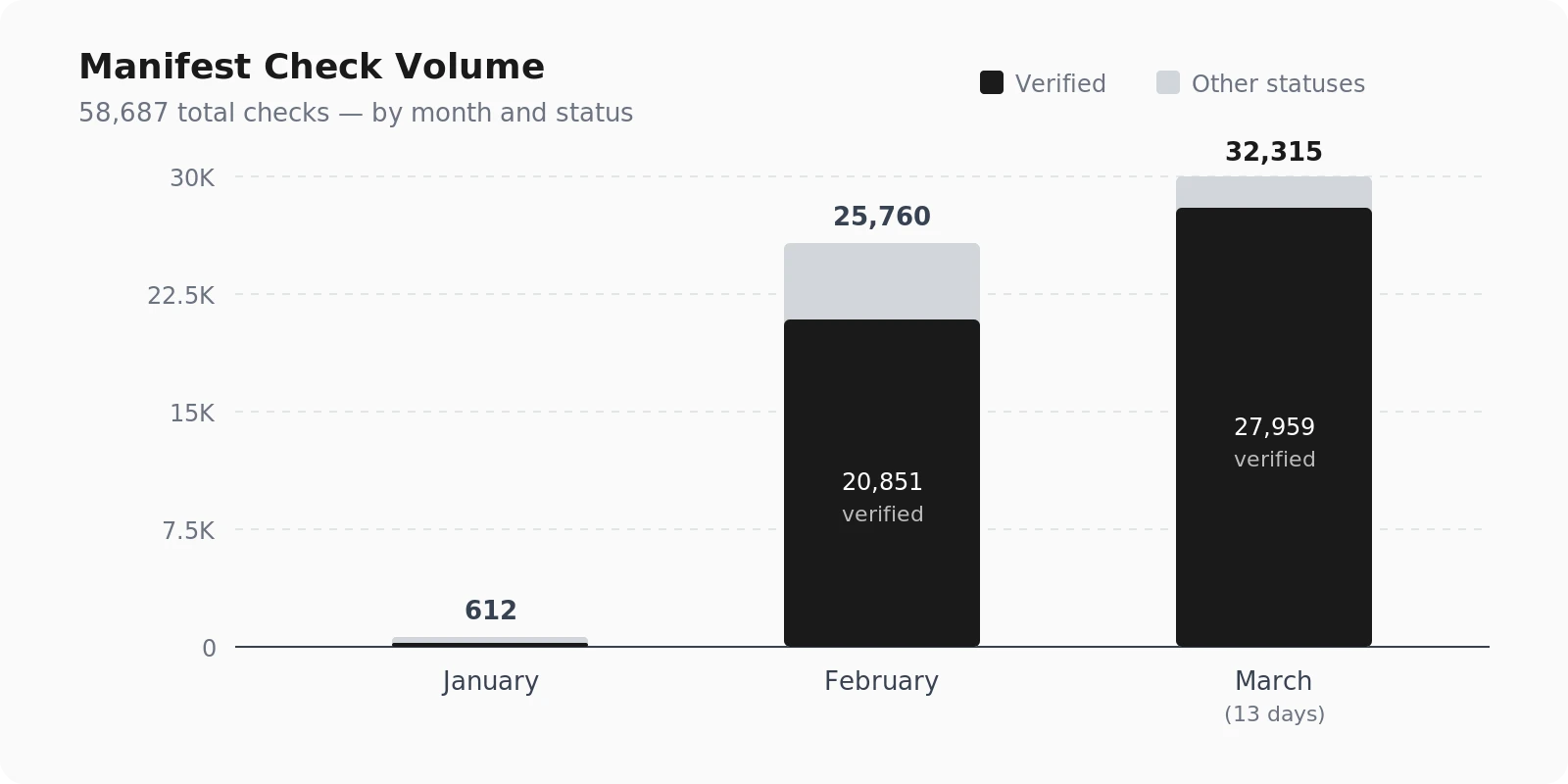
Our crawl infrastructure has scaled with this growth. We ran over 58,000 individual domain checks through mid-March, up from ~24,000 through late February. March alone accounts for 32,000+ checks — more than January and February combined — with the vast majority returning verified status.
Beyond Shopify: generic platforms appear
This is the most significant shift in the data since launch. Of the 1,183 stores we've benchmarked, 285 are now classified as "generic" — meaning they're running UCP on non-Shopify infrastructure.
In February, 100% of benchmarked stores were Shopify. Now it's 76% Shopify, 24% other platforms.
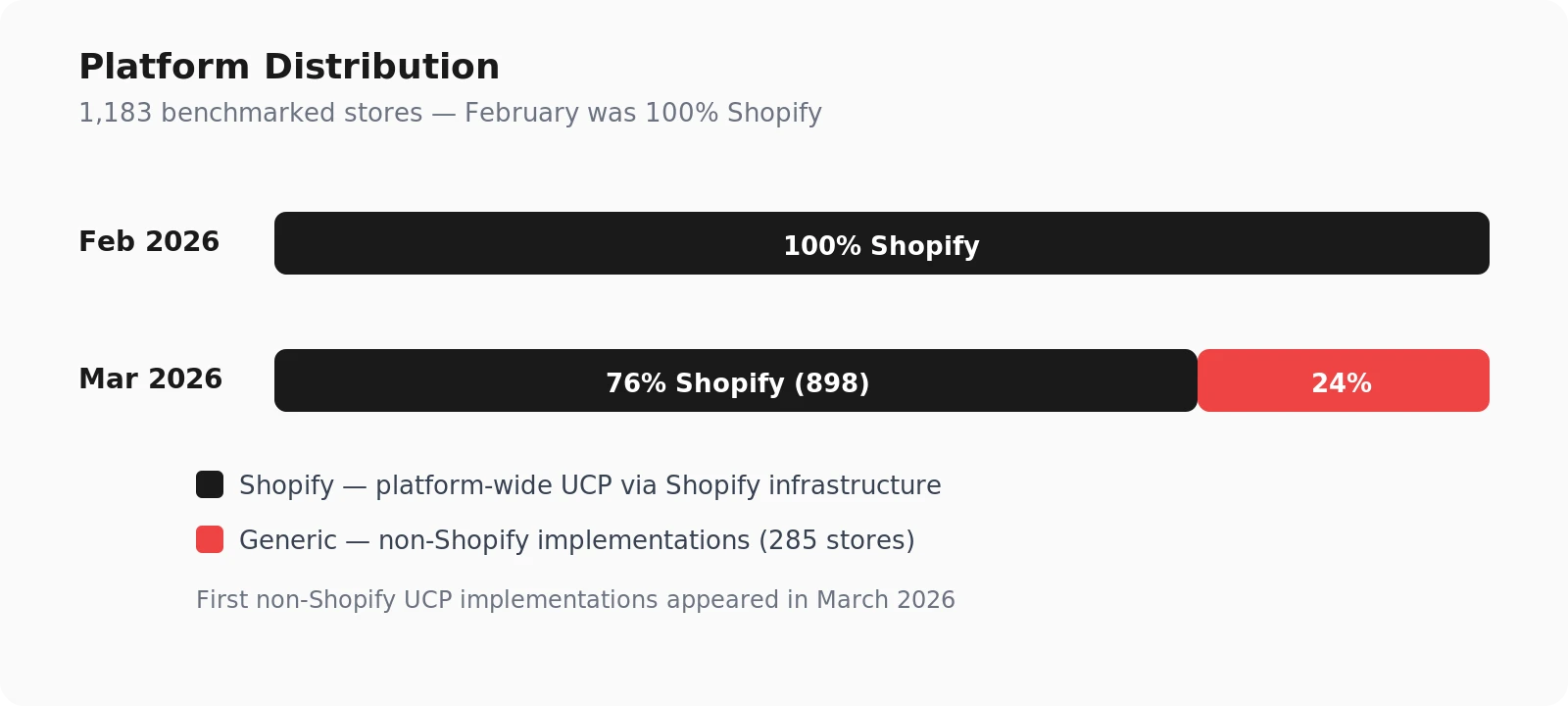
We're cautious about reading too much into this yet. Some of these may be custom implementations, developer test endpoints, or early-stage platform integrations. But the signal is clear: UCP is no longer a Shopify-only story. Third-party developers and platforms are building against the spec.
The grade distribution across all 1,183 benchmarked stores tells the quality story:
| Grade | Count | % |
|---|---|---|
| A | 9 | 0.8% |
| B+ | 422 | 35.7% |
| B | 222 | 18.8% |
| C+ | 84 | 7.1% |
| C | 141 | 11.9% |
| D | 16 | 1.4% |
| F | 289 | 24.4% |
Average score: 56.3 out of 100.
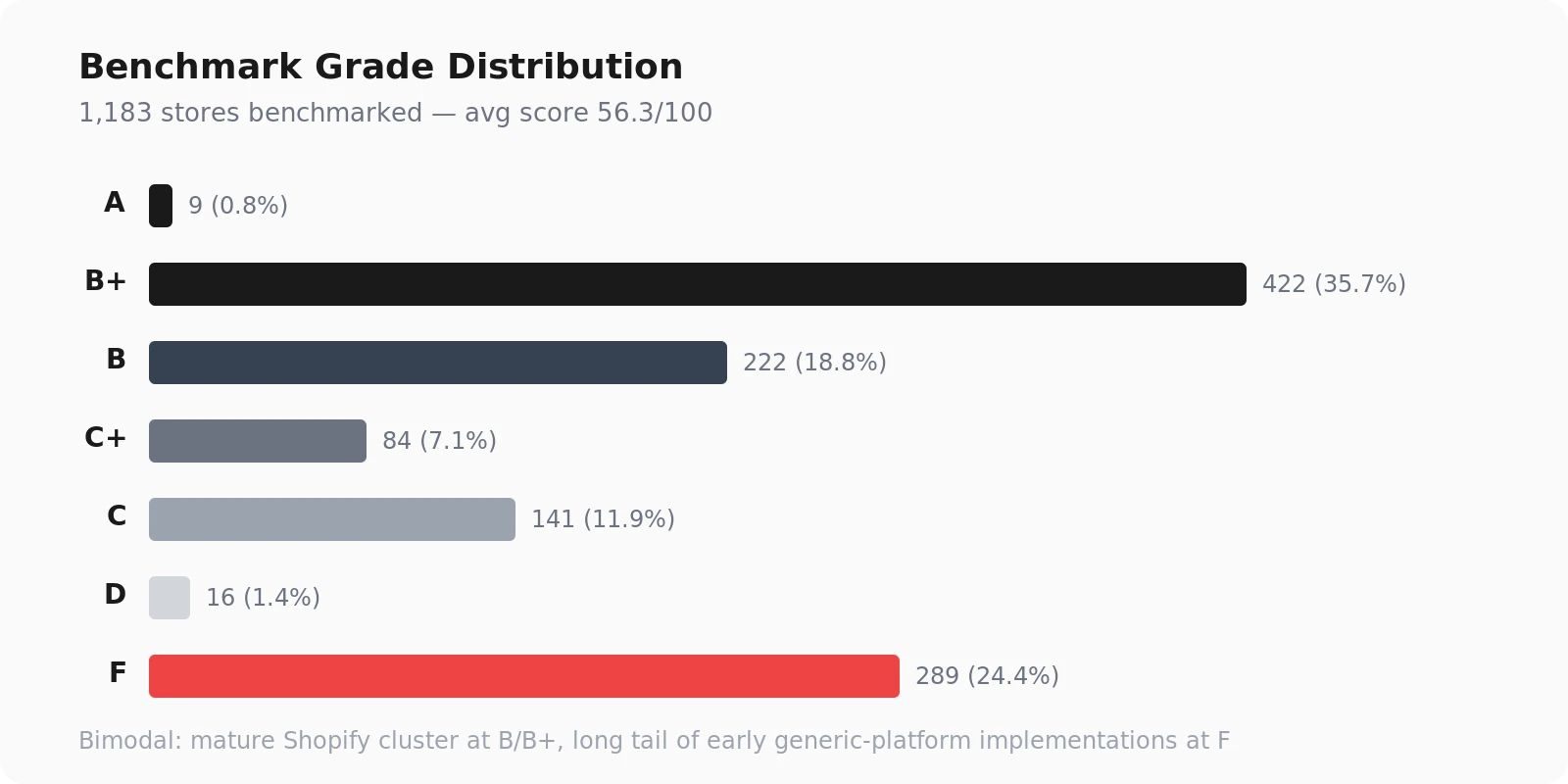
The bimodal distribution is notable — a large cluster of B/B+ stores (the well-maintained Shopify merchants) and a long tail of F-graded stores. Many of those F grades come from enterprise stores that haven't yet publicly exposed their full UCP manifests. The endpoints exist, but capability coverage is thin — often limited to basic catalog discovery with checkout, cart, and post-purchase tools either missing or returning errors. This is exactly what you'd expect in early adoption: the launch platform has mature implementations, and larger merchants are still rolling out support incrementally.
Our monitoring continues to show manifest flapping — stores moving between valid and invalid states over time. This is normal for an early protocol ecosystem, but it underscores that discovery is growing faster than implementation maturity. Manifests exist. The question is whether agents can reliably transact against them.
Discovery is scaling. Reliability is the real infrastructure problem.
We've been testing agent-to-store interactions across multiple LLMs on UCP Playground, and the pattern is consistent: stores with well-defined schemas and deterministic API behavior significantly outperform stores with vague or incomplete tool definitions.
This shouldn't be surprising, but it's worth stating plainly: in agent commerce, the API is the storefront. Traditional ecommerce optimizes for human browsing — product pages, search filters, visual merchandising. Agent commerce optimizes for tool schemas: clear parameter definitions, consistent response formats, predictable behavior. The stores that score highest in our audits aren't necessarily the biggest brands — they're the ones with the cleanest data.
We continue seeing three categories in the wild:
Stable implementations — valid manifests, working tools, consistent schemas, reliable checkout flows. Agents interact with these successfully.
Partial implementations — manifests exist but have issues: incomplete schemas, incorrect tool responses, missing capabilities, inconsistent cart behavior. Agents often fail mid-interaction.
Unstable implementations — broken endpoints, invalid manifests, deployments that appear and disappear. These stores are detectable but not usable.
As agents interact with more stores, tooling around reliability becomes essential. Manifest monitoring, agent testing environments, and capability registries are beginning to form the observability layer that agentic commerce needs. This is a big part of why we built UCP Alerts.
Embedded commerce is emerging as the default pattern
One of the clearest patterns from both our testing and the spec activity is the rise of embedded checkout.
Rather than completing the entire purchase autonomously, the dominant agent flow we see is:
- Agent discovers products via the manifest
- Agent assembles a cart
- Agent presents the transaction to the user
- User is redirected to merchant checkout to complete payment
This hybrid model — agent assistance plus human approval plus merchant-controlled payment — is pragmatic. It sidesteps the hardest trust problems (who authorized this purchase?) while still delivering most of the value (the agent did the discovery, comparison, and cart assembly).
The spec reflects this. PR #247 introduces link delegation for the embedded transport, letting agents hand off specific interactions to merchant-hosted experiences. PR #244 adds a cart transport binding with a re-authentication mechanism. These aren't afterthoughts — they're becoming core architecture.
Heiko Hotz framed this well in his O'Reilly piece on the agentic commerce revolution: the future is likely a "polyglot commerce" world where agents handle discovery and cart negotiation, and merchants retain control of the payment flow. Embedded experiences may become the dominant early architecture for agent commerce — not as a compromise, but as the model that actually works for both sides.
The spec is moving toward commerce reality
The UCP GitHub repository has seen intense activity. With 2,500 stars, 304 forks, and 189 total PRs, the project is one of the most active open commerce specs in recent memory.
The Tech Council — the governing body that reviews and approves spec changes — has been meeting weekly. We reviewed the minutes from February 27 and March 6, and the PRs filed since our last report. The protocol is now focused on solving real commerce problems, not discovery problems. Here's what's in flight:
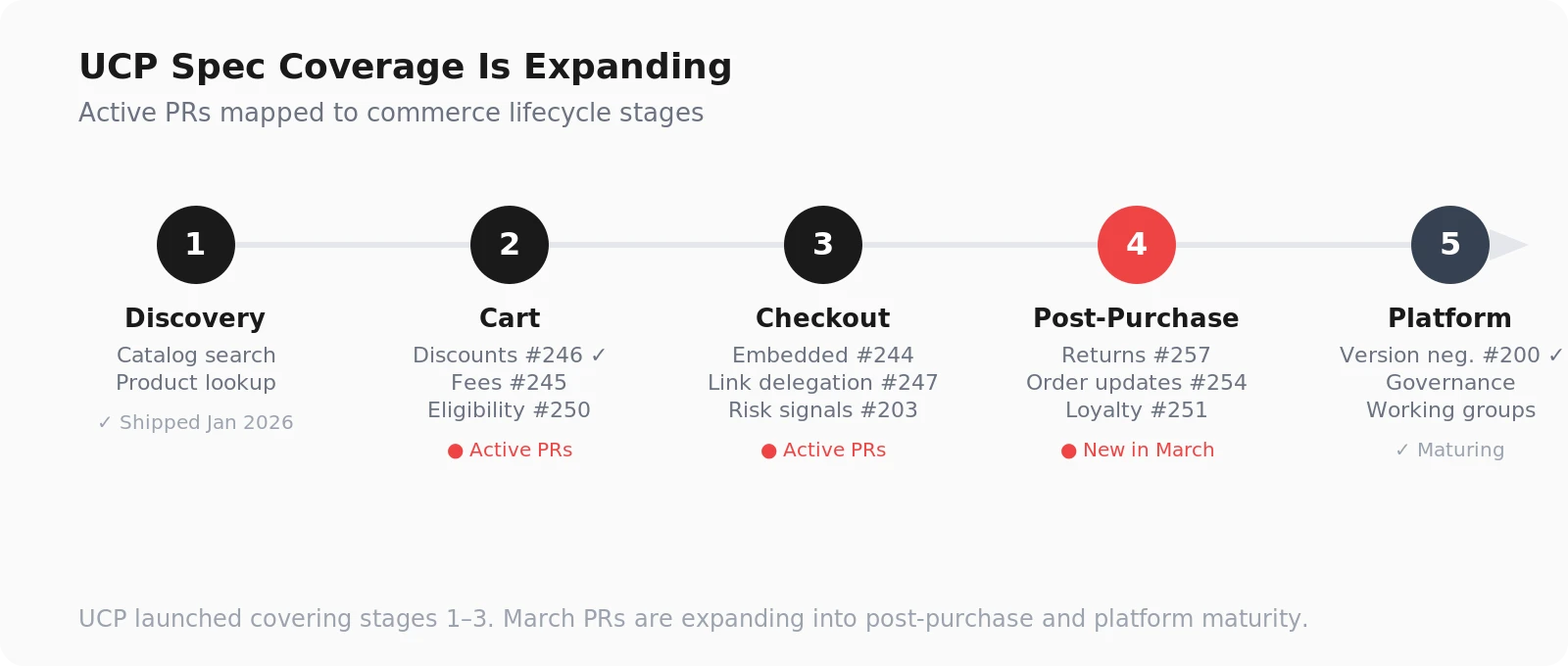
Returns (PR #257): A return extension for the UCP spec — the first post-purchase capability being formalized. This matters because without return handling, automated purchasing is too risky. Agents need to understand return windows, refund methods, and eligibility rules.
Order updates (PR #254): A breaking update to the Order capability. Early versions assumed orders were immutable. Real commerce includes partial refunds, replacements, quantity adjustments, and post-purchase modifications. This PR reflects that reality.
Loyalty (PR #251): A basic schema for loyalty program extensions. The TC minutes show active debate between Etsy, Target, and Shopify about whether loyalty should be tied to identity or treated as a separate lifecycle. 24 comments and counting. Agents may need to verify loyalty status and redeem points before completing checkout — which introduces new protocol needs around eligibility and identity.
Eligibility claims (PR #250): A context-level primitive for modeling eligibility — payment-instrument-specific discounts, membership benefits, verification-gated pricing. 21 comments. The TC agreed to model this as an enhancement to the existing discount capability.
Fee extensions (PR #245): Itemized fees for checkout and cart — bagging fees, road improvement levies, regulatory surcharges. 39 comments, the most-discussed PR this month. How fees, taxes, and totals are represented matters enormously: agents cannot misinterpret the final price, especially in regulated markets.
Cart discounts (PR #246): Extending the discount capability from checkout-only to cart-level. Merged on March 11.
Link delegation (PR #247): An extension for the embedded protocol transport, allowing agents to hand off specific interactions to merchant-hosted experiences.
Risk signals (PR #203): Authorization and abuse signals. The TC agreed the primitive is necessary and should live in the protocol rather than a side channel. Pending legal/privacy review.
Version negotiation (PR #200): Clarifying how businesses and platforms negotiate protocol version compatibility. Merged on March 7 after weeks of discussion.
The pattern is clear: UCP is expanding from "search and checkout" toward the full commerce lifecycle — returns, loyalty, fees, discounts, risk management, and multi-version support. These are the same problems every commerce platform eventually faces. The spec is being shaped by people who actually run commerce platforms (Shopify, Etsy, Google, Stripe reps are all on the TC), and the debates in the meeting minutes reflect real implementation experience, not theoretical standards work.
Governance is maturing
The TC is also formalizing its governance. The February 27 minutes reference proposals for elected TC seats (four seats, rotating every six months) and Domain Working Groups — a mechanism to bring in deep-domain experts (payments specialists, logistics providers) who aren't on the core TC. These are the structures you'd expect from a protocol aiming for industry-wide adoption.
The March 6 meeting acknowledged that the pace feels slow relative to ambition — long review cycles, contributors spread thin — and approved standing working sessions to help the group move faster. The fact that they're self-diagnosing tempo issues two months in is a healthy sign.
Retail was the launch surface — but it's not the end state
Retail storefronts still dominate the open ecosystem. Most public manifests come from Shopify deployments and experimental developer stores.
But developers are already building against the protocol in entirely different verticals. Prototype stores are emerging that represent multi-vendor marketplaces, aggregator inventories, and B2B procurement flows. Some are building travel-adjacent implementations with booking sessions, availability windows, and ancillaries.
We've been tracking this on the tooling side too. In v0.9.4 of UCP Playground, we shipped first-class support for B2B procurement — step patterns, outcomes, and agent prompts for create_rfq, get_quote, and submit_po tools — and travel/booking support with detection for search_hotels, get_hotel_details, create_booking_session, and complete_booking. These weren't theoretical additions. Developers were submitting sessions with non-retail tool schemas, and the playground was misclassifying them as failed because it only understood the retail shopping funnel. Now it doesn't.
This matches the discussions currently happening in the spec repository. The Hotels extension and Ancillaries extension PRs are early, but they signal that the community sees UCP as a general commerce protocol, not a retail-only one.
Retail may have launched the ecosystem — but the developers building against the spec are already thinking broader.
The ecosystem update
Since our February report, the broader ecosystem has continued to develop:
Splitit announced on March 5 that it's backing UCP, bringing card-linked installment payments to AI agent checkout flows. This is the first "buy now, pay later" provider to publicly commit to the protocol.
PayPal publicly backed UCP as part of its expanded partnership with Google.
Google formalized the merchant onboarding path for UCP-powered checkout. The Merchant Center help page and developer implementation guide now lay out the full pipeline: prepare your Merchant Center account (product feed, shipping, returns), set up Google Pay via the Wallet Console, publish a UCP profile so Google can negotiate capabilities and discover payment handlers, then implement three core REST endpoints for session creation, updates, and completion. An optional embedded checkout path exists for merchants with complex checkout logic. The feature is currently US-only, limited to select merchants, and requires Google approval before going live — but there's a waitlist form for interested merchants. Google's FAQ clarifies some important details: merchants remain the seller of record, payments flow through existing PSPs via Google Pay tokenization (no Google Pay button required on your own site), real-time inventory checks happen before the "Buy" button is enabled, and the merchant's own terms and conditions govern each transaction. Two integration paths are offered — native (Google handles checkout logic within AI surfaces, recommended for full agentic capability) and embedded (merchant-controlled checkout UX embedded within Google's surface). At launch, integrations appear on AI Mode in Search and the Gemini web app, with the Gemini mobile app and other surfaces planned. Etsy and Wayfair remain the live partners, with Shopify, Target, and Walmart expected to follow.
Shopify's Agentic plan — a new tier that opens the Shopify Catalog to every brand — was announced, expanding the commerce backbone that connects merchants to AI agent surfaces.
The endorsed partner list continues to grow. Checkout.com and Affirm were both added to the UCP documentation in February, joining the existing roster of Adyen, American Express, Mastercard, Stripe, and Visa.
On the analysis side, Heiko Hotz's O'Reilly Radar piece offered a useful mental model for separating the protocol landscape: UCP as the "store" (catalog, inventory, cart logic), AP2 as the "wallet" (secure mandates), and ACP as the "cashier" (checkout conversation). His argument — that major retailers will adopt UCP for agent-accessible inventory while using either AP2 or ACP for payment depending on the surface — matches what we're seeing in the two-track adoption story we described in February.
What we shipped
On the UCP Checker side:
UCP Playground — our agent shopping simulator — launched in late February and has shipped 10 releases since. It now supports 11 LLMs across Anthropic, Google, OpenAI, Meta, xAI, and DeepSeek, three transports (MCP, REST, and Embedded), multi-model comparison mode, embedded checkout via the Embedded Commerce Protocol, and — as of v0.9.4 — B2B procurement and travel/booking verticals. The full changelog tells the story of what breaks when agents actually try to shop: malformed UUIDs from Gemini Flash, phantom cursor values from GPT-5.2, empty-array schema bugs that crash Claude, and checkout sessions orphaned by models that don't understand cart state. Every fix is a lesson about what model-agnostic commerce infrastructure actually requires.
UCP Alerts — continuous manifest monitoring with notifications when a store's UCP status changes. We're now running 2,000+ checks daily.
Browser extension deep dive — we published a technical breakdown of how the Chrome extension became our single largest discovery channel, feeding 1,480 domains into the monitoring pool with a 98.4% verified rate.
What to watch in April
Three things we're tracking heading into next month:
Non-Shopify adoption. The 285 generic-platform benchmarks are the leading indicator. If WooCommerce, BigCommerce, or Magento start shipping UCP integrations, we'll see it in the data first.
Post-purchase capabilities. Returns (PR #257), loyalty (PR #251), and order management (PR #254) are all in active review. When these merge, UCP stops being a "discovery and checkout" protocol and becomes an end-to-end commerce standard. As Hotz puts it, the question isn't whether agents can buy things — it's whether they can operate safely inside real commerce systems.
Google's production rollout. Shopify, Target, and Walmart are all named as coming to Google AI Mode checkout. When that goes live, the two-track adoption story we described in February starts to converge — and the volume of real agent transactions will jump dramatically.
This report is based on data from UCP Checker and UCP Playground as of March 13, 2026. All data referenced is from our own crawling, monitoring, and agent testing infrastructure. For questions or corrections, reach out at ucpchecker.com.
Sources
- Google Developers Blog: Under the Hood — UCP (Jan 11, 2026)
- Shopify Engineering: Building the Universal Commerce Protocol
- Google: UCP-Powered Checkout in AI Mode (Feb 12, 2026)
- Shopify: The Agentic Commerce Platform
- Heiko Hotz: The Agentic Commerce Revolution — O'Reilly Radar (Feb 5, 2026)
- Heiko Hotz: Why Your Website Is Invisible to AI Agents — LinkedIn
- Google Merchant Center: About UCP and UCP-Powered Checkout on Google
- Google Developers: UCP Implementation Guide
- Google Developers: UCP FAQ
- Splitit Backs Google's Universal Commerce Protocol (Mar 5, 2026)
- PayPal CEO Alex Chriss endorses UCP (Jan 12, 2026)
- Tobi Lütke: Shopify is building the foundation for agentic commerce (Jan 11, 2026)
- UCP GitHub Repository
- UCP Technical Council Meeting Minutes
- UCP Checker: State of Agentic Commerce — February 2026
- UCP Checker: Why We Built UCP Playground
- UCP Checker: We Monitored 2,000 UCP Manifests. Then We Built UCP Alerts.
- UCP Checker: How a Browser Extension Became Our Biggest Discovery Engine
- UCP Playground Changelog
Check your domain's UCP status
See if your storefront is ready for agentic commerce in seconds.
The State of Agentic Commerce — September 2026
Shopify moved 10,600 stores to the August release in two days, identity linking reached 7,355 stores, Wix started switch...
The State of Agentic Commerce — August 2026
UCP shipped its most consequential release yet in August — payment lifted out of shopping, location made first-class, 3D...
The State of Agentic Commerce — July 2026
UCP crossed 11,414 verified stores this month (+38%) — but the capability histogram is a cliff, and it hits zero at the...
Get the agentic commerce digest every Monday
Real adoption data, ecosystem trends, new spec versions, and the stores that broke or recovered this week. Read by founders and engineers building the next generation of commerce.