
Which stores can Meta's Muse actually buy from in the UK? A personal AI agent has to reach a lot of stores, and Muse does it three ways. It has hand-built connectors for some big names. It speaks open protocols for the long tail: UCP for checkout, and Poppy (the Personal Agent Protocol) for talking to a company's own systems. And for everyone else, it opens the store's website in its own browser, as a person would.
On 26 November 2026 we asked Muse, in a fresh chat on a UK account, which shops, travel and delivery services it can work with directly, how it connects to each, and whether it can actually buy or only search. It answered with a table. This post reproduces that table in full and explains what it means for retailers, platforms, payment providers and people building agents.
Everything below is what Muse told us when we asked, plus what we saw on screen. These are the agent's own descriptions, as of 26 November 2026. They are not a view of Meta's systems, and they may change as Muse changes.
Does Meta Muse use UCP?
Yes. Muse told us it uses the Universal Commerce Protocol (UCP) to check out products, and it listed UCP as one of its built-in connections with "Yes, buy" beside it. In short, as Muse described it:
- It reads the store's public
/.well-known/ucpprofile, then calls the store's own UCP endpoint. - It has one route for Shopify stores and a direct route for a merchant that speaks UCP itself.
- It pays with Stripe Link or Shop Pay. If the store accepts neither, it goes to the store's own checkout page in its browser.
- It does not use UCP Ask today.
Public write-ups disagree on this point, and most reason from outside. This is the agent's own account, dated, so it can be asked again and compared. The detail is in the section "What UCP gives a store here", below.
The setup
- Agent: Meta's Muse, on the web, UK account. Muse reported its model as Muse Spark 1.3.
- Date: 26 November 2026, 13:06 UTC, in a new chat with no earlier context.
- Question (verbatim): "Which shops, travel and delivery services can you work with directly through a built-in connection (not just by browsing their website)? For each one, please say how you connect (their own API or MCP server, UCP, Poppy, or something else) and whether you can actually buy or book through it, or only search. A table would be great."
- Follow-ups: earlier the same day, in a separate chat, we asked Muse how its UCP and Poppy support works. Those answers are used in the sections on UCP and Poppy.
- Method: plain questions typed into the chat, as any user could ask them. No purchases were made.
Tested with
- Agent: Meta's Muse, web app (muse.ai)
- Model, as Muse reported it: Muse Spark 1.3
- Account country and language: United Kingdom, English
- Dates (UTC): 26 November 2026. Connections table at 13:06; UCP, Poppy and Ask follow-ups from 10:55
- UCP: Muse named no protocol version; it said it follows the version each store's profile declares. Latest UCP release on the day: 2026-08-25
- Poppy: Muse said it speaks 0.3 and 0.4. Latest published version on the day: 1.0
- Wallets Muse named for UCP checkout: Stripe Link, Shop Pay
We will ask the same questions again when Muse, UCP or Poppy changes, and add a dated note comparing the answers.
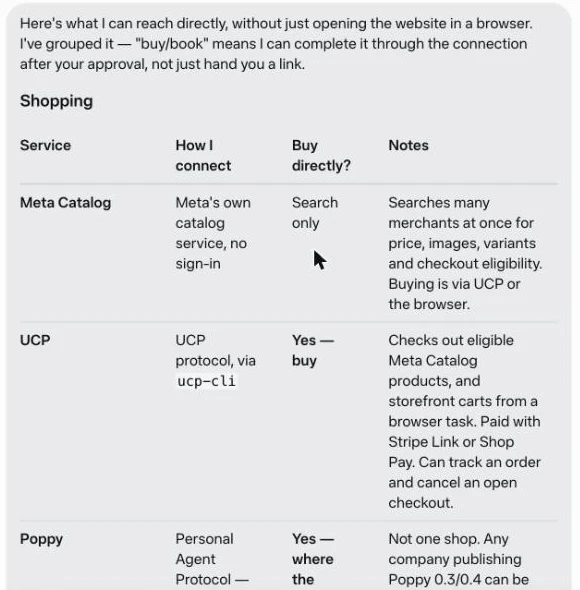
Muse's built-in connections
As Muse described its own built-in connections when we asked, 26 Nov 2026 (UK account). Muse grouped them into three tables. We have kept its grouping, its wording for "how it connects" and "buy directly?", and lightly trimmed the notes. Muse's own definition: "buy/book" means it can complete the purchase through the connection after the user approves, not just hand over a link.
Shopping
| Service | How Muse connects | Buy directly? | Notes (lightly trimmed) |
|---|---|---|---|
| Meta Catalog | Meta's own catalog service, no sign-in | Search only | Searches many merchants at once for price, images, variants and checkout eligibility. Buying is via UCP or the browser. |
| UCP | UCP protocol, via ucp-cli | Yes, buy | Checks out eligible Meta Catalog products, and storefront carts from a browser task. Paid with Stripe Link or Shop Pay. Can track an order and cancel an open checkout. |
| Poppy | Personal Agent Protocol: the company's published Poppy document, via their API and MCP tools in the browser | Yes, where the company supports it | Not one shop. Any company publishing Poppy 0.3/0.4 can be used this way, with the cart and sign-in shared between the API and their website. Muse still confirms the action with the user first. |
| Argos (UK) | Own connector | Search only | Search, product details and stock for delivery or collection. You buy on argos.co.uk. |
| Debenhams (UK) | Own connector | Basket only, then link | Search, sizes, stock, prices and a guest basket. Payment happens on debenhams.com via a checkout link. |
| LOOKFANTASTIC, MYPROTEIN, CULT BEAUTY | Own connector, with your account connected | Basket only, then link | Search, basket, wishlist, orders and rewards. Checkout is a link to pay on their site. |
| Walmart (US) | Official MCP server, beta | Yes, buy | Search, cart and place orders you approve, using your saved address and payment. Your Walmart account has to be enabled for the MCP server. |
| Deal.ai (US) | Own connector, free account | Search only | Live prices, deals and comparisons across Amazon, Walmart, Target and Best Buy. |
| Capital One Shopping | Own connector | Search only | Reward rates, coupons and featured offers. |
| Facebook Marketplace | Facebook's own connector / API | Yes, buy/sell | Via your Facebook account. |
| Piki (Mexico) | Own connector | Yes, buy, via its checkout page | Search and buy second-hand items. You see the full total first, then pay on Piki's checkout page. |
| ForthClear | Own connector | Search / preview only | Business marketplace for surplus and returned lots. Search, ask for quotes and preview checkout; you pay on their site. |
| Shelvio / eBay | Own connector | Manage Shelvio items only | Manages items in Shelvio. Some actions (eBay listings, connecting eBay, marking items sold) are done in the Shelvio app or site. |
| Shopify | Official merchant MCP server | No, merchant side, not shopping | For running a Shopify store: products, inventory, orders, customers, discounts. Shopper checkout on Shopify stores is via UCP, above. |
| Printify | Own API, via your personal access token | Merchant fulfilment only | Print-on-demand for a merchant's shops. Not consumer shopping. |
Travel
| Service | How Muse connects | Book directly? | Notes (lightly trimmed) |
|---|---|---|---|
| Duffel | Own connector, no user login; payment via Stripe Link | Yes, book | Search, book and cancel flights from many airlines, reserve or cancel pay-at-pickup rental cars, add paid bags. |
| Expedia | Own connector; guest access, or your connected account | Yes, book, for native-checkout rates | Search and price lodging, book rates that support native checkout, look up bookings. |
| Agoda | Own connector, no sign-in | Search only | Hotels, flights, tours, tickets and experiences. Booking continues on Agoda's website via a link. |
| easyJet | Own connector, read-only, no sign-in | Search only | Flights, holiday packages and live status. Book via a link or the site. |
| Ryanair | Own connector, no sign-in | Search only | Lowest fares, fare calendars, routes and self-transfer connections. You book on ryanair.com. |
| Despegar (Mexico/Brazil) | Own connector | Search only | Search and compare flight itineraries, flexible dates and deals. |
| FlightAware | Managed FlightAware service, no account | Status only | Schedules, live status, positions, tracks and airport activity. |
| Google Travel | No network call; builds Google Hotels/Flights URLs | Search helper only | Muse builds the address, then a browser task reads the prices. Booking is in the browser. |
| OpenTable | Own connector, no account needed | Yes, book | Live availability; make, change or cancel restaurant reservations. |
| Ticketmaster | Own connector, no setup | Search only | Search events and available seats and prices. Purchase continues in the browser via the checkout link. |
| Tabico | Own connector, account required | Planning only | Itineraries, sights, hotels, transport legs, expenses, packing lists and to-dos. |
| JustPark (UK) | Own connector | Search only | Search bookable parking and read your bookings. |
Groceries, food delivery and parcels
| Service | How Muse connects | Buy/book directly? | Notes (lightly trimmed) |
|---|---|---|---|
| Instacart | Official Instacart service | Cart, then checkout link | Search groceries and manage your cart at a chosen store. Checkout via the Instacart link or browser. |
| Gopuff (US) | Own connector, with your account | Yes, order | Instant delivery; quote, place, track and cancel orders. |
| PCExpress (Canada, Loblaw) | Official service, with your PCID account | Cart, then link | Checkout on the retailer's website via a returned link. |
| Carrefour (France) | Official service | Cart only, then browser | Slot booking and checkout are on carrefour.fr. |
| Peristyle Grocery Cart | Own connector | Build cart only | Recipes and meal plans into a Kroger or Walmart cart. |
| Rappi (Mexico/Brazil) | Official MCP server | Cart prep, then link | Orders are placed in Rappi. |
| Grab | Official MCP server | Yes, order/book, with in-app approval | GrabMart grocery orders and Dine-out reservations; GrabMart orders also need approval in the Grab app. |
| Sweetgreen (US) | Own connector | Bag, then link | Checkout link on order.sweetgreen.com. |
| Uber Courier | Own connector, with your Uber account | Yes, book a delivery | Quotes, booking, tracking and cancellation for local parcel deliveries. |
| Warp | Own connector, account required | Yes, book a shipment | Freight and parcel rates, booking, tracking. |
Tested with: Meta's Muse on the web (muse.ai), UK account, English · model as Muse reported it: Muse Spark 1.3 · 26 November 2026, 13:06 UTC. One answer in a new chat; the list can differ by account and country.
Muse added two notes under the tables, quoted here:
"Payments behind several of these are separate wallets, not shops: Stripe Link, Shop Pay and PayPal. UCP, Duffel and Expedia pay with Link; UCP can also use Shop Pay."
"And for context, given you're in the UK: Lakeland, Currys, John Lewis, Bosch, Tesco, Deliveroo, Uber Eats, DoorDash, Uber rides, Booking.com and Trainline have no built-in connector I found — those are browser-only for me, even though I can search many of them via Meta Catalog or the live browser."
Reading the table
Muse listed 37 rows across the three groups. They fall into four kinds of connection.
Buy or book inside the agent. UCP, Poppy (where the company supports it), Walmart, Facebook Marketplace, Piki, Duffel, Expedia (native-checkout rates), OpenTable, Gopuff, Grab, Uber Courier and Warp. Here Muse can complete the purchase after the user approves it.
Basket, then a link. Debenhams, LOOKFANTASTIC, MYPROTEIN, CULT BEAUTY, Instacart, PCExpress, Carrefour, Rappi, Sweetgreen and Peristyle. Muse can find products and build a basket. The shopper then pays on the retailer's own site.
Search and information. Meta Catalog, Argos, Deal.ai, Capital One Shopping, ForthClear, Agoda, easyJet, Ryanair, Despegar, FlightAware, Google Travel, Ticketmaster, Tabico and JustPark. Muse can search, compare and check stock or prices. Buying happens elsewhere.
Merchant tools, not shopping. Shopify's merchant MCP server, Printify and Shelvio help a business run its shop. They are not routes for a shopper to buy.
Four things stand out.
Most big-name connectors stop short of payment. Of the UK retail connectors Muse listed, all hand the shopper back to the retailer's site to pay. That is a design choice as much as a limit: the retailer keeps its own checkout, its own payment page and its own customer relationship. Some connectors also limit what an agent may do on the user's behalf.
UCP and Poppy are the only rows that are not one company. Every other row is a single brand. UCP and Poppy are open protocols, so one integration on Muse's side reaches every store or company that speaks them. As of November 2026, about 1.2 million of 3.7 million live ecommerce sites (31.8%) publish a valid public UCP profile, according to the UCP Checker market read. Publishing a profile is the first step. As the next section shows, Muse also needs a product it can check out and a wallet the store accepts.
Meta Catalog is the front door. Muse described Meta Catalog as "search only", but it is where checkout eligibility comes from. Its notes say buying from a catalog product goes "via UCP or the browser".
Payment sits in a few wallets. Muse named three: Stripe Link, Shop Pay and PayPal. On UCP it pays with Link or Shop Pay. Duffel and Expedia pay with Link. The wallet, not the store, is where the shopper's card lives.
What UCP gives a store here
Earlier the same day we asked Muse how its UCP checkout works. Here is what it told us, in short.
- It reads the store's own profile. Muse said its UCP client reads the store's public
/.well-known/ucpprofile to find the store's UCP endpoint and the payment handlers it accepts. It also said it reads the home page's regional store links (hreflang) to find the store that serves the shopper's country. - The catalog says whether checkout is possible. For a Meta Catalog product, Muse said the catalog tells it whether a product can be checked out over UCP, and by which route. If not, it falls back to checkout in the browser.
- It calls the store directly. Muse said checkout calls go straight to the merchant's endpoint over HTTPS, not through Meta as a proxy. It said the transport is MCP (JSON-RPC), using the UCP checkout and catalog lookup capabilities.
- The store's checkout decides. Muse said "the checkout endpoint makes the final decision", whatever the catalog flags say.
- Approval comes at the end. Muse said the user approves the exact quote (items, final total, delivery choice, masked card) before it completes the checkout, and that it only reports an order as placed once the store confirms it.
The limits Muse told us about
- Two routes. Muse described two UCP routes. One is for Shopify stores, checked out through Shopify's UCP checkout. The other is for a non-Shopify merchant that speaks UCP directly. Muse said it knows of one named example of the direct route.
- Two wallets. Muse said it can complete a UCP checkout only when the store accepts a payment handler that Link or Shop Pay can pay. If not, or if the shopper picks PayPal or a card saved with the merchant, it continues on the store's own checkout page instead.
- One merchant per checkout. On the Shopify route, Muse said a cart holds one merchant only, and Shopify may change the currency to match the delivery address.
- No UCP Ask yet. Ask (
dev.ucp.common.ask) is part of UCP's 2026-08-25 release, added to it on 2 November 2026, so a store can answer plain-language questions about products, policies or orders. Muse said it does not use Ask today. For store questions it uses catalog details, the product or policy page, a Poppy conversation, or a retailer's own agent where a connector has one (it named Walmart's). - Version. Muse said it could not name a single UCP protocol version from what it can read; it follows the version the store's profile declares.
Tested with: Meta's Muse on the web (muse.ai), UK account, English · model as Muse reported it: Muse Spark 1.3 · 26 November 2026, from 10:55 UTC. Muse's own description of its UCP checkout; no checkout was run.
Poppy: any company, versions 0.3 and 0.4
Poppy, the Personal Agent Protocol, lets a person's agent find a business, sign in on the person's behalf and use the business's APIs or agent, starting from one file at /.well-known/poppy.json.
In the table, Poppy is "not one shop": "any company publishing Poppy 0.3/0.4 can be used this way". In the follow-up chat, Muse told us:
- It looks for
https://{domain}/.well-known/poppy.json, fetched with no session and no credentials, and can follow other versions listed undersupported_versions. - It checks the file parses, the domain matches, the version is one it speaks, and it only calls the endpoints the file declares.
- Sign-in uses the company's OAuth, on the company's own page. Credentials never pass through the chat.
- It talks to a company's agent over Poppy's own conversation protocol. A business action, such as a booking or order, needs the user's approval of that exact proposal.
On versions. Poppy 1.0 was published in mid November 2026. Muse told us it speaks 0.3 and 0.4. A site can serve 1.0 and still list a 0.4 document under supported_versions, so agents on either version can reach it.
Poppy in practice. On the same day we watched Muse find a small B&B's poppy.json, pick its 0.4 version and call the site's API, with an approval card for each step.
Meta Muse and UK stores
We asked from a UK account, so the answer shows how Muse reaches British retailers. Three UK rows in its table have a connector, and none of them takes payment inside the agent: Argos is search only, Debenhams builds a guest basket and hands over a checkout link, and LOOKFANTASTIC, MYPROTEIN and CULT BEAUTY build a basket with the shopper's account connected and then link out to pay. easyJet and JustPark are search only.
Muse then closed its answer with a UK list of names it has no built-in connector for: Lakeland, Currys, John Lewis, Bosch, Tesco, Deliveroo, Uber Eats, DoorDash, Uber rides, Booking.com and Trainline. In its words, "those are browser-only for me, even though I can search many of them via Meta Catalog or the live browser."
Browser-only does not mean unreachable. It means Muse opens the site in its own browser, reads it and, where the shopper wants, checks out there as a person would. The connector, the protocol and the browser are three routes to the same store.
A travel contrast. In a separate test the same day, we asked Muse to find places to stay in the Scottish Highlands. Where an OTA connector had stock, it came back first and led on price. Where none did, Muse went to owners' own sites and booking calendars.
What it means for you
Retailers
- Without a connector, the protocol is your route. Most stores will never get a hand-built connector. Publish a valid UCP profile so an agent can check out, and a Poppy document if you want an agent to sign shoppers in and use your systems.
- Be in the catalog the agent searches. Muse said buying from a catalog product goes through UCP or the browser, and the catalog is where checkout eligibility comes from. Keep your product feed complete and current.
- Make the wallets work. Muse completes UCP checkout only with Link or Shop Pay. Check which payment handlers your UCP profile declares, and keep your regional store links (hreflang) accurate.
Platforms
- One platform integration reaches every store on it. Muse's Shopify route shows how a platform-level UCP checkout makes a whole platform's stores buyable at once.
- A direct route exists for non-Shopify merchants. Muse described a direct route for merchants speaking UCP themselves. Platforms that serve UCP profiles can make sure each store's profile is valid, names a working endpoint and lists payment handlers agents can pay.
- Serve Poppy versions agents speak. If you publish Poppy 1.0, list 0.4 under
supported_versionsso agents that have not moved yet can still find your merchants.
Payment providers
- Agent checkout runs through a few wallets today. Muse named Stripe Link, Shop Pay and PayPal, and uses Link and Shop Pay for UCP.
- The handler list decides. A store's UCP profile declares payment handlers. If none matches a wallet the agent holds, Muse said it falls back to the store's own checkout page.
- Approval is per quote. Muse said a wallet connection or an earlier "buy it" does not count as approval. The user approves the exact total each time.
Agent builders
- Three routes, one store. Hand-built connectors, open protocols and a browser each have a place. Muse uses all three and says so per store.
- Read the store's own documents. Muse reads
/.well-known/ucpand/.well-known/poppy.jsonfrom the store, and lets the store's checkout make the final decision. - Say what you can and can't do. Muse's table separates "buy", "basket then link" and "search only" clearly. That kind of statement helps stores and shoppers know what to expect.
What we'll watch
- Whether Muse adds UCP Ask, or more UCP rails beyond the Shopify route and its one named direct example.
- Whether more wallets or payment handlers appear for UCP checkout.
- When Muse moves to Poppy 1.0.
- Whether UK names now listed as browser-only gain connectors or protocol routes.
- How the table changes over time. We'll ask the same question again and date the answer.
FAQ
Does Meta Muse use UCP?
Yes. As of 26 November 2026, Muse told us it uses the Universal Commerce Protocol (UCP) to check out eligible products, reading each store's /.well-known/ucp profile and paying with Stripe Link or Shop Pay.
Which stores work with Meta Muse? Muse listed 37 built-in connections when we asked on 26 November 2026, across shopping, travel, groceries and delivery. Beyond those, it reaches any store that speaks UCP with a wallet it can pay, any company publishing Poppy 0.3 or 0.4, and other sites through its browser.
Which stores can Meta Muse buy from? Muse said it can buy directly through UCP, through Poppy where a company supports it, and through a few connectors such as Walmart (US) and Facebook Marketplace. For many other stores it builds a basket and hands over a checkout link, or uses its browser.
Does Muse work with Argos? Muse told us it has an Argos connector for search, product details and stock. Buying happens on argos.co.uk.
Can Meta Muse buy from Shopify stores? Muse said shopper checkout on Shopify stores goes through UCP, on a Shopify route. Its Shopify MCP connector is for merchants running a store, not for shopping.
Does Muse use a shopping protocol like ACP or UCP? Muse told us it uses UCP for checkout and Poppy for working with a company's own systems. We also asked about OpenAI's ACP. Muse answered "No / not documented", and said it found no ACP checkout route in what it can read.
Can non-Shopify stores sell through Meta Muse? Muse described a direct UCP route for a non-Shopify merchant and said it knows of one named example. For other stores it uses its browser on the store's own site, or Poppy where the company publishes it.
Do Shopify stores need to do anything to work with Muse? Muse said shopper checkout on Shopify stores goes through UCP on a Shopify route, for products Meta Catalog marks as eligible, paid with Shop Pay or Link. The settings that control this are on Shopify's side; check Shopify's own documentation.
Is Meta Muse available in the UK? Yes. We ran this test on a UK account on 26 November 2026.
Does Meta Muse support Poppy (PAP)?
Yes. Muse said it works with any company that publishes a Poppy 0.3 or 0.4 document at /.well-known/poppy.json.
What payment methods does Meta Muse use? Muse named three wallets: Stripe Link, Shop Pay and PayPal. For UCP checkout it uses Link or Shop Pay.
Does Muse use UCP Ask?
Not as of 26 November 2026. Muse told us it does not use dev.ucp.common.ask. It answers store questions from catalog data, the store's pages, Poppy or a retailer's own agent.
Which UK stores are browser-only for Muse? Muse listed Lakeland, Currys, John Lewis, Bosch, Tesco, Deliveroo, Uber Eats, DoorDash, Uber rides, Booking.com and Trainline as having no built-in connector. It reaches them through its browser and, for many, Meta Catalog search.
About UCP Checker
UCP Checker is the independent validation and observability layer for the Universal Commerce Protocol. We crawl, validate and grade every public UCP manifest we can find, run the merchant directory, the UCP Score, live adoption stats, the vertical guides and the authority-bound vendor map, and track the spec as it evolves so you don't have to — measured from two vantages (what a business declares, and what actually happens when an agent transacts), the same way for everyone, without picking winners.
Sources
- Muse chat, UK account, 26 November 2026, 13:06 UTC: the built-in connections table reproduced above.
- Muse chat, UK account, 26 November 2026, from 10:55 UTC: follow-up answers on UCP, Poppy and Ask.
- UCP adoption stats. UCP Checker market read, November 2026.
- Ask capability. Universal Commerce Protocol specification, 2026-08-25 release.
- Personal Agent Protocol. Version 1.0, November 2026.
Related coverage: How UCP's Ask works, step by step · How the Personal Agent Protocol and UCP fit together · How a UCP order works, step by step · Buyer-side shopping skills