
A shared run in UCP Playground can now be read in the buyer's language. Playground's own labels change: the checkout status, the totals, the search lines, how the run ended, the play bar and the share menu. Money changes with them. The store's text and the agent's words stay exactly as they were sent. Shipped on 24 November 2026 in Playground 0.24.235.
Six languages so far: English, Traditional Chinese (Hong Kong), Brazilian Portuguese, Latin American Spanish, German and Czech. The timing is not an accident. UCP's three proposed regional working groups, for APAC, EMEA and LATAM, all list local currency display in their charters. Building it also shows clearly where the spec stops and the platform starts.
What is a shared run in the buyer's language?
It is the same recorded run, with the words Playground writes shown in the language of the person the agent shopped for. A run's buyer language is set under Who it shops for before the run starts. Playground already sends it to the store as context.language where the store's tools accept it. Now the shared page and its embed use it too.
Only Playground's own words are translated. A product name, the store's wording for a total, a message from the store and everything the agent says are shown as sent, in whatever language they were written.
How it works, step by step
- The run has a buyer language. Set under Who it shops for, sent to the store as an IETF BCP 47 tag such as
zh-Hant-HKorpt-BR. - The shared link picks it up. Open the shared run or its embed and Playground's labels follow that language. A tag we don't have yet is shown in English.
- Or name one on the link. Add
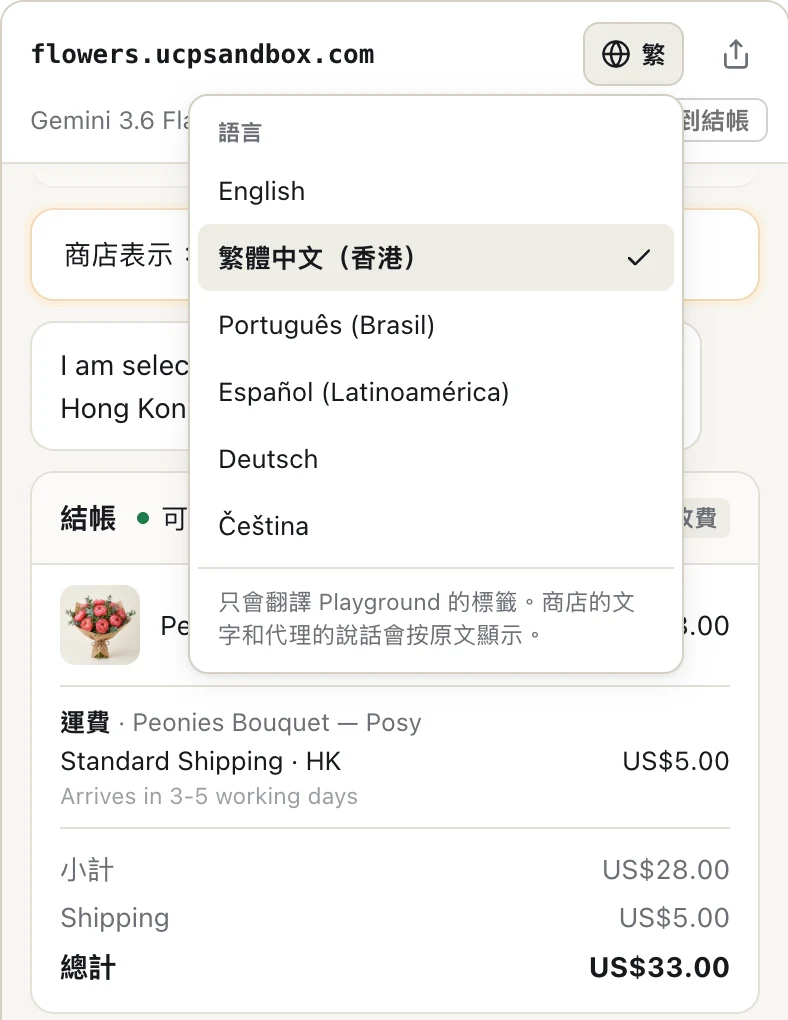
?lang=to choose another, for example?lang=zh-Hant-HKor?lang=pt-BR. One run can be shown in two languages this way. - Or pick one on the embed. A globe beside Share lists the languages, each in its own name. Picking one reloads the replay in that language at the same moment. The links the share menu copies keep the language you chose.
- Money follows the language. The amount and the currency are the store's. Only the way they are written changes.
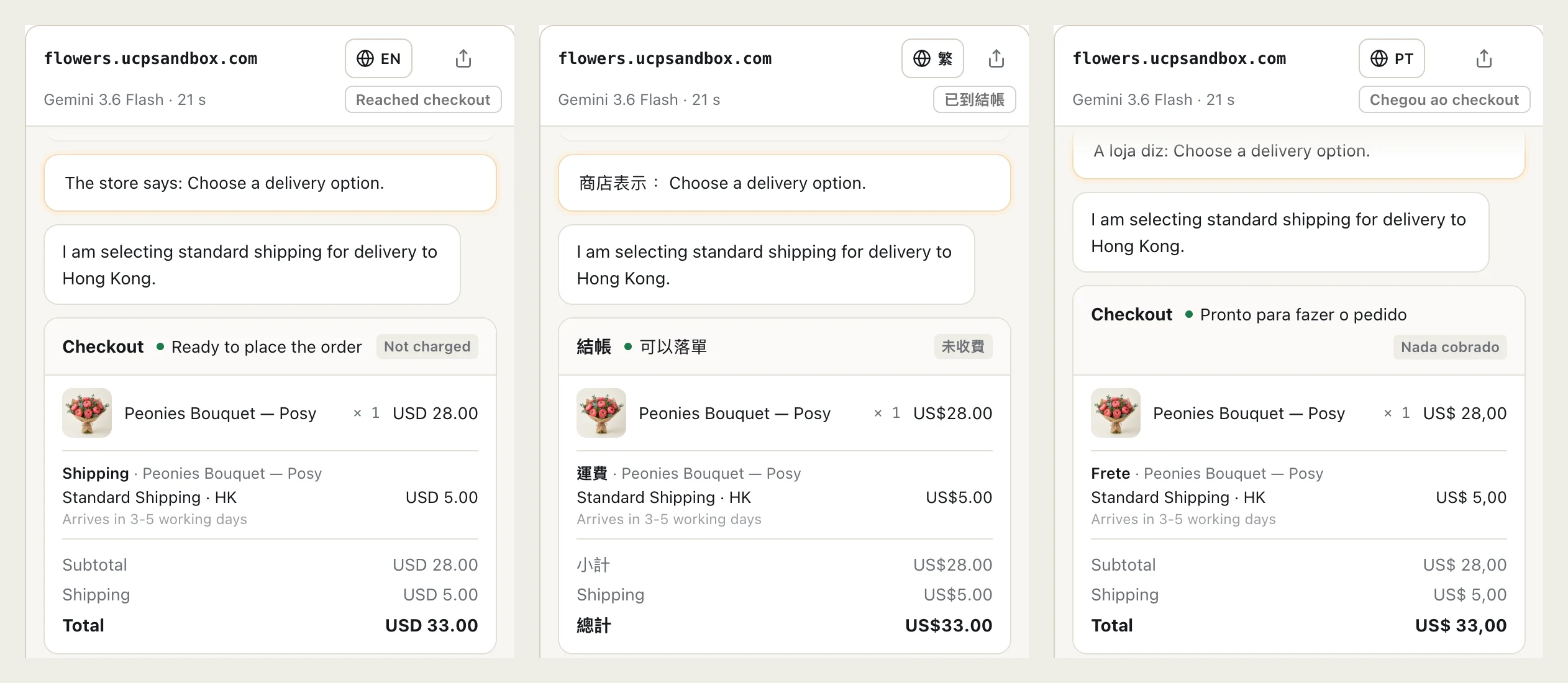
The side-by-side picture above shows the same moment in three languages. The run shopped for a buyer in Hong Kong, with zh-Hant-HK as the language and Hong Kong dollars as the preferred currency. The store still priced the bouquet in US dollars, as the spec lets it: the buyer's currency is a hint, and the store decides. So every version shows US dollars. What changes is the label and how the amount is written.
| Language | Status | Total |
|---|---|---|
English (en) |
Ready to place the order | USD 33.00 |
Traditional Chinese, Hong Kong (zh-Hant-HK) |
可以落單 | US$33.00 |
Brazilian Portuguese (pt-BR) |
Pronto para fazer o pedido | US$ 33,00 |
Look at the line under the subtotal. It says "Shipping" in all three languages, while Playground's own label for the delivery method above it changes (運費, Frete). The "Shipping" line is the store's own text for the total (display_text), so it is shown as sent. So is the store's message, "Choose a delivery option.", and the agent's reply, which it wrote in English in all three.
Tested with: 24 November 2026, UTC · UCP Playground 0.24.235 · one shared run on flowers.ucpsandbox.com (buyer: Hong Kong,
zh-Hant-HK, HKD as the preferred currency; the store priced in USD; standard shipping to Hong Kong, not paid) · agent: Gemini 3.6 Flash · captures of the production embed with?lang=set tozh-Hant-HK,pt-BRanden
Play it below, or open it with the full trace.
What the spec fixes, and what it leaves to the platform
UCP 2026-08-25 fixes the data. The amount schema (common/types/amount.json) says:
"Monetary amount in the currency's minor unit as defined by ISO 4217. Refer to the currency's exponent to determine minor-to-major ratio (e.g., 2 for USD, 0 for JPY, 3 for KWD)."
Every price carries an explicit three-letter currency code. The buyer's signals are hints, not orders:
- Language.
context.languageuses IETF BCP 47 tags. The release says businesses "MAY return content in a different language if unavailable." - Currency.
context.currencyis a preferred currency. "Businesses determine presentment currency from context and authoritative signals." On the checkout, the schema puts it as "buyers provide signals, merchants determine currency." - Totals. A total has a type and optional
display_text, the store's own words to show against the amount.
What the release does not say is how a platform writes money on screen, or what language its own labels are in. USD 33.00, US$33.00 and US$ 33,00 are all the same amount. Choosing between them is the platform's job. So is translating "Order placed".
That is the gap the regional groups point at. The APAC charter (#1117) lists "local currency formatting". EMEA (#1118) lists local currency formatting across multi-currency catalogs. LATAM (#1119) lists "formatted local currency display". All three were opened on 20 November 2026 as charter proposals for Governing Council approval, with nominations open (discussion #1120). The Governing Council's 13 November minutes say members "agreed in principle" and were completing a final review. As of 24 November the charters are not yet approved, and no group has reported. Each would run for eight weeks after approval and deliver recommendations, not spec changes. We covered the charters in UCP regional working groups: APAC, EMEA and LATAM.
What it doesn't do
- Shared run and embed only. The live run page and Inspect are still in English.
- The language menu is on the embed only. The full shared page has no menu yet. Use
?lang=on its link. - First-draft translations. None of the five has been read by a native speaker yet. Playground's changelog asks people to say where a phrase reads wrong.
- Six languages. Any other tag is shown in English.
- It doesn't translate the store or the agent. Product names, the store's totals text and messages, and the agent's words stay as sent.
- It doesn't change the currency. The store decides it; Playground only writes it.
What it means for stores
- Your words reach the buyer as you sent them. If you want a total to read "運費" rather than "Shipping", put that in
display_textfor the buyer's language. Playground won't rewrite it. context.languageis worth reading. Playground sends the buyer's language with its catalog searches wherever your tool acceptscontext. A shared run now makes it easy to see what your store answered in that language, side by side with our labels.- Check your minor units. Send amounts in the currency's minor unit and the right currency code. A yen store that sends
118means ¥118; a client that divides by 100 will show ¥1.18.
What it means for agent builders
- Read amounts by the currency's exponent. Don't divide every amount by 100: a yen amount has no decimals and a dinar amount has three.
- Keep the store's text and your own labels apart. Translate what you write. Show what the store wrote as it wrote it.
- Format money in the buyer's locale, from the store's currency. The spec gives you the amount and the code. The format is yours to choose.
FAQ
How do I show a shared Playground run in another language?
Add ?lang= to the shared link or the embed, for example ?lang=pt-BR. On the embed you can also pick a language from the globe beside Share.
Which languages does UCP Playground support for shared runs?
English, Traditional Chinese (Hong Kong), Brazilian Portuguese, Latin American Spanish, German and Czech. Any other tag is shown in English.
Does Playground translate the store's product names or the agent's answer?
No. Only Playground's own labels and the money format change. The store's text and the agent's words are shown as sent.
How are amounts written in UCP?
As a whole number in the currency's minor unit under ISO 4217, read by the currency's exponent: 2 for US dollars, 0 for Japanese yen, 3 for Kuwaiti dinars. Every price carries an explicit currency code.
Does UCP say how to format prices on screen?
No. Release 2026-08-25 fixes the amount, the currency code and the language tag. How a platform writes money and labels on screen is left to the platform.
What is context.language in UCP?
A buyer signal with the preferred language, as an IETF BCP 47 tag such as zh-Hant-HK. It is a hint: the store may answer in another language if it doesn't have that one.
Are the UCP regional working groups approved?
Not yet. The APAC, EMEA and LATAM charters were proposed on 20 November 2026 with nominations open, and await Governing Council approval. You can follow open proposals on our Changes to UCP tracker.
About UCP Checker
UCP Checker is the independent validation and observability layer for the Universal Commerce Protocol. We crawl, validate and grade every public UCP manifest we can find, run the merchant directory, the UCP Score, live adoption stats, the vertical guides and the authority-bound vendor map, and track the spec as it evolves so you don't have to — measured from two vantages (what a business declares, and what actually happens when an agent transacts), the same way for everyone, without picking winners.
Sources
- UCP Playground changelog. Version 0.24.235, 24 November 2026.
- History and replays: the language of a shared run. UCP Playground docs.
- Glossary: Amounts and Language. UCP Playground docs.
- Amount schema,
common/types/amount.json. UCP release 2026-08-25. - Context schema,
common/types/context.json. UCP release 2026-08-25. - Checkout schema,
shopping/checkout.json. UCP release 2026-08-25. - DWG Charter: UCP for APAC (#1117). Charter proposal, open, awaiting Governing Council approval, 20 November 2026.
- DWG Charter: UCP for EMEA (#1118). Charter proposal, open, awaiting Governing Council approval, 20 November 2026.
- DWG Charter: UCP for LATAM (#1119). Charter proposal, open, awaiting Governing Council approval, 20 November 2026.
- Inviting nominations for UCP Regional Domain Working Groups (#1120). GitHub discussion, 20 November 2026.
- Governing Council minutes, 13 November 2026. UCP meeting minutes.
- The shared run used in this post. UCP Playground, Gemini 3.6 Flash on the UCP Sandbox Flowers test shop, 24 November 2026.
Related coverage: UCP regional working groups: APAC, EMEA and LATAM · Playground: pinned models and the November refresh · Playground 0.24: runs, Inspect and history · UCP fulfillment, step by step